
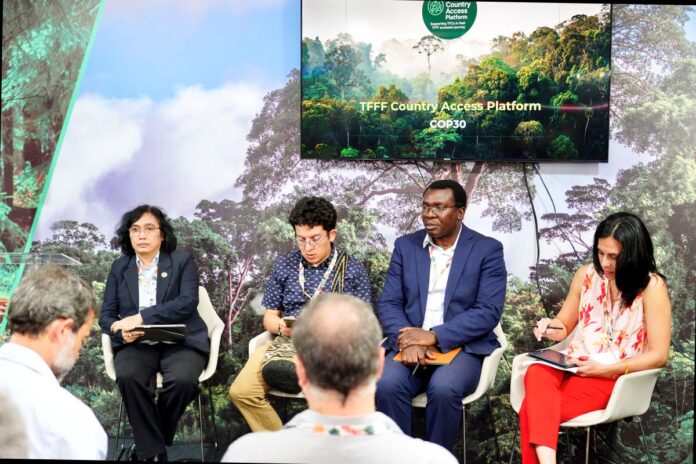
Ecobiz.asia — The Government of Brazil has launched a new digital platform designed to help tropical forest countries access financing from the Tropical Forest Forever Facility (TFFF), on the sidelines of the UNFCCC COP30 climate conference in Belém on Saturday (Nov. 15, 2025).
The platform, called the TFFF Country Access Platform, will function as a central hub providing information and technical support for tropical forest countries to meet TFFF eligibility criteria, while also facilitating South–South collaboration.
The platform is voluntary, open to all countries, and operates independently from the governing structure of the TFFF.
Its launch follows the historic declaration of the TFFF at the COP30 Leaders’ Summit on 6 November, which has received endorsement from 53 countries, including 34 tropical forest nations.
TFFF is an innovative blended-finance mechanism designed to provide incentives for countries to keep forests standing. To date, it has secured more than US$5.5 billion in initial commitments from Brazil, Norway, Indonesia, as well as France, Portugal, the Netherlands, and others.
Indonesia is among the first countries to express full support for the initiative.
During the launch session of the TFFF Country Access Platform, Haruni Krisnawati, Senior Advisor on Climate Change to the Minister of Forestry, participated as a panelist, representing Indonesia, which also sits on the TFFF Interim Steering Committee.
Haruni emphasized that the new platform could accelerate long-term climate finance access for tropical forest countries, including supporting Indonesia’s national FOLU Net Sink 2030 target, under which the forestry sector is expected to become a net carbon sink.
“Indonesia welcomes the TFFF Country Access Platform as an efficient, transparent, and responsive mechanism for the needs of tropical forest countries,” she said.
“This platform is essential for strengthening countries’ capacity to access long-term finance, improve forest monitoring systems, and ensure accountable public financial governance that delivers tangible benefits for Indigenous peoples and local communities,” Haruni added.
Indonesia stated its readiness to collaborate both as a beneficiary and as a provider of technical expertise to other countries. Indonesia also reaffirmed its commitment to supporting the process toward formal access to the TFFF and to strengthening global partnerships aimed at protecting tropical forests as part of climate solutions.
The session featured representatives from UNDP, the Democratic Republic of the Congo, Colombia, as well as civil society organizations including WWF, TNC, CI, WCS, FAO, and WRI.
Stakeholders noted that the platform could become an important bridge between tropical forest countries and the global technical community, underscoring the importance of transparency, data integrity, accountability, and inclusive governance. ***