

Ecobiz.asia — Indonesia has launched a national program to develop 100 gigawatts peak (GWp) of solar power capacity, with an estimated investment of about US$73 billion (more than Rp1,140 trillion) and a target to complete the program within three years.
President Prabowo Subianto launched the program at the Gilimanuk Solar Power Plant (PLTS) site in Jembrana, Bali, on Tuesday (Aug. 25, 2026). The first phase covers 14 solar projects across six provinces with a combined capacity of about 5.3 GWp.
“We will build 100 gigawatts. We are serious about it. Our target is 100 gigawatts within three years,” Prabowo said at the launch.
The 14 projects are located in West Java, Central Java, East Java, Bali, Bangka Belitung Islands and Riau Islands.
Energy and Mineral Resources Minister Bahlil Lahadalia said the 100 GWp program would require about US$73 billion in investment. Beyond expanding renewable power capacity, the program is expected to reduce government spending and fuel consumption, create jobs and cut carbon emissions.
“The total investment for the 100 gigawatts is approximately US$73 billion, equivalent to more than Rp1,140 trillion,” Bahlil said.
He said the program could reduce government subsidies by around Rp73.9 trillion per year and create an estimated 5.52 million jobs cumulatively.
The program is also expected to cut diesel consumption by around 6 million kiloliters a year nationwide. Its development could reduce carbon emissions by an estimated 140.16 million tonnes of CO2 per year.
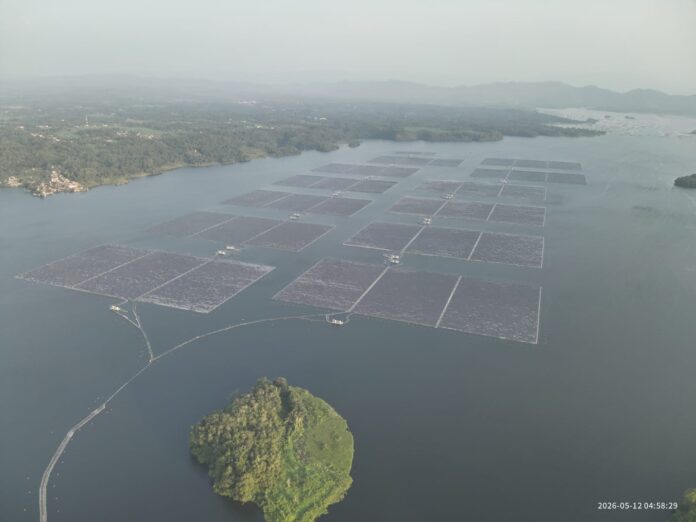
The first phase includes four projects launched as part of the program: the 300 MWp Gilimanuk Solar Power Plant, the 134 MWp Gajah Mungkur Floating Solar Power Plant, the 0.92 MWp Sembur Village Solar Power Plant and the 0.078 MWp Pulau Rengit Solar Power Plant.
The program also includes solar projects in island communities and areas that have historically faced limited electricity supply.
The Sembur Village project, for example, is intended to support fishermen’s economic activities by supplying electricity to a five-tonne cold-storage facility and a four-tonne ice-making machine.
Meanwhile, the Pulau Rengit project is expected to increase electricity availability for residents from around 12 hours to 24 hours a day. The project is also projected to reduce the cost of electricity supply by around Rp4,400 per kWh, or 26%.
The government is also linking the solar program to the development of a domestic renewable-energy industry. Bahlil said Indonesia already has domestic manufacturing capacity for solar panels and battery energy storage systems (BESS).
“Through the 100 GWp solar program, we will truly stand on our own feet,” Bahlil said.
The launch was conducted simultaneously with the Gajah Mungkur floating solar project in Central Java, the Sembur Village solar project in the Riau Islands and the Pulau Rengit solar project in the Bangka Belitung Islands.
Beyond solar power, the government is positioning the development of domestic energy resources as part of a broader effort to strengthen Indonesia’s energy independence.
Prabowo said Indonesia also has significant geothermal, gas and oil resources that need to be developed to reduce dependence on imported energy.
The president said the 100 GWp solar program must move beyond a plan and be demonstrated through actual project development over the next three years.
“We will prove it again. Three years from now, we will gather again. We now always talk with proof,” Prabowo said. ***