

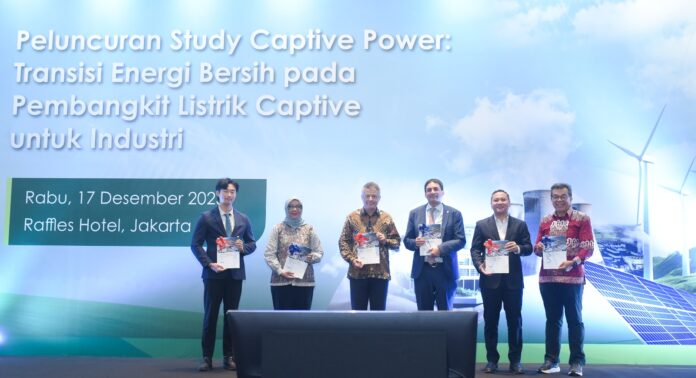
Ecobiz.asia — The Secretariat of Indonesia’s Just Energy Transition Partnership (JETP) on Wednesday (Dec. 17, 2025) launched a thematic study aimed at accelerating the decarbonization of the country’s captive power sector, which currently accounts for nearly a quarter of national installed electricity capacity and remains heavily reliant on coal.
The Captive Power Study Thematic Report provides an analytical framework and policy recommendations to support the transition of electricity generated by private industries for their own use toward cleaner energy sources, in line with Indonesia’s long-term climate targets.
The study was completed under the coordination of the Coordinating Ministry for Economic Affairs (CMEA), with support from the European Union through the EU–Indonesia Cooperation Facility (EU-ICF), and serves as a complement to the Comprehensive Investment and Policy Plan (CIPP) 2023 within the JETP framework.
Vice Chair of the Energy Transition and Green Economy Task Force (Satgas TEH), Rachmat Kaimuddin, said emissions from captive power generation must be addressed to meet Indonesia’s net-zero emissions target by 2060 without undermining industrial competitiveness.
“Indonesia has both a growth and a net zero ambition. This means the industrial sector using captive power must also decarbonize. But we need to ensure that the solutions are competitive and reliable—so Indonesia can continue its transition from an extractive economy to an industrialized economy while protecting the environment,” Rachmat said.
The report identifies structural and operational factors behind the continued reliance on coal, including limited grid connectivity in industrial areas and the need for stable and continuous power supply, particularly for energy-intensive industries such as metal smelters.
Head of the JETP Secretariat Paul Butarbutar said the energy transition agenda goes beyond emissions reduction and must also support sustainable economic growth and energy security.
“Through a series of analytical studies, including the Comprehensive Investment and Policy Plan, the JETP Secretariat has identified key challenges and opportunities related to the transition of captive power,” Butarbutar said.
“The Captive Power Study Thematic Report provides recommendations that can inform policy development and strengthen the framework for a just and orderly energy transition.”
He added that growing awareness of climate change is increasing demand for products produced through low-carbon processes, making the decarbonization of captive power increasingly important for Indonesia’s industrial competitiveness. ***