

Indonesia’s Second NDC Targets Lower Peak Emissions, Minister Hanif Says

MORE ARTICLES

Ecobiz.asia — Indonesia has officially submitted its Second Nationally Determined Contribution (Second NDC) to the UNFCCC, setting more ambitious greenhouse gas (GHG) reduction targets than the previous Enhanced NDC.

Minister of Environment Hanif Faisol Nurofiq said Indonesia’s new climate document introduces an emission target below the 2019 emission level, which now serves as the base year. Under the new approach, Indonesia aims to peak its GHG emissions at 1.3 gigatons CO₂e under the low-emission scenario (LCCP-L) and 1.4 gigatons CO₂e under the high-emission scenario (LCCP-H) by 2030.

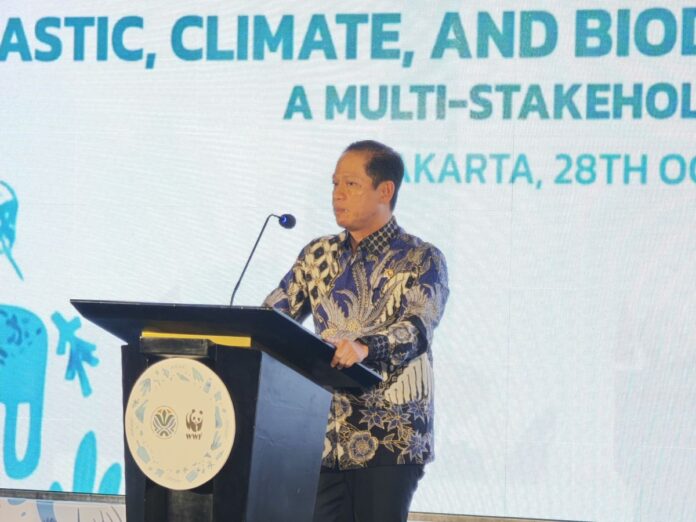
“Compared to the Enhanced NDC, the Second NDC is more ambitious. The figures we submitted to the UNFCCC are higher than those in the previous document,” Hanif said during the Multi-Stakeholder Dialogue: Plastic, Climate and Biodiversity Nexus Forum in Jakarta, Tuesday (Oct. 28, 2025).

Read also:  Indonesia Hosts International Peat Fire Suppression Training with Global Partners

The previous Enhanced NDC projected Indonesia’s peak emissions at 1.9 gigatons CO₂e with domestic efforts (Countermeasure 1) and 1.6 gigatons CO₂e with international support (Countermeasure 2). Based on the new Low Carbon Compatible with the Paris Agreement (LCCP) framework, Indonesia’s target represents an 8–17.5% reduction from the 2030 projections under the Enhanced NDC.

Under the LCCP scenarios, Indonesia is expected to reach peak emissions in 2030 with estimated levels of 1,345,707 Gg CO₂e under LCCP-L and 1,491,474 Gg CO₂e under LCCP-H, before gradually declining by 2035 to 1,257,717 Gg CO₂e (LCCP-L) and 1,488,866 Gg CO₂e (LCCP-H).

Read also:  Forestry Ministry Foils 796 kg Pangolin Scale Smuggling, Arrests Vietnamese National

The emission reduction focus covers five key sectors: energy, waste, agriculture, industrial processes and product use (IPPU), and forestry and other land use (FOLU). The FOLU sector remains the backbone of mitigation, targeting FOLU Net Sink 2030, the restoration of 2 million hectares of peatland, and rehabilitation of 8.3 million hectares of degraded land.

In the energy sector, the government aims for a 19–23% share of renewables by 2030 and 70% by 2060. Implementation is supported by several key regulations, including Government Regulation No. 33/2023 on energy conservation, Presidential Regulation No. 112/2022 on renewable energy acceleration, and Presidential Regulation No. 110/2025 on carbon pricing instruments.

Read also:  Indonesia Prepares Forestry Carbon Nesting Framework, Riau Selected as Pilot

The Second NDC also highlights the integration of mitigation and adaptation efforts through programs such as the Climate Village Program (ProKlim), the strengthening of the National Registry System (SRN) connected to the Indonesia Stock Exchange for carbon trading, and the application of just transition principles to ensure an inclusive and equitable energy transition.

The government estimates a total investment requirement of USD 472.6 billion through 2035 to implement the Second NDC, partly funded through the national budget and managed by the Environmental Fund Management Agency (BPDLH). ***


LATEST STORIES

MORE ARTICLES

Survey Finds Indonesia’s Renewable Energy Progress Stagnant Despite Strong Industry Demand

Ecobiz.asia — A recent survey conducted by Petromindo Survey highlights growing industry concern over the slow pace of renewable energy development in Indonesia, despite...

Indonesia Prepares Three Schemes for Biodiversity Credit Implementation

Ecobiz.asia — Indonesia is preparing three key schemes to implement high-integrity biodiversity credits as part of efforts to strengthen biodiversity financing and promote a...

Indonesia Prepares Forestry Carbon Nesting Framework, Riau Selected as Pilot

Ecobiz.asia — Indonesia is preparing to operationalize a forestry carbon nesting framework to support high-integrity transactions and attract global investment into its carbon market. Director...

Industry Welcomes Indonesia’s New Forestry Carbon Trading Regulation

Ecobiz.asia — Industry players have welcomed Indonesia’s issuance of Forestry Minister Regulation No. 6/2026, saying it provides greater certainty and strengthens the foundation of...

Indonesia, South Korea Strengthen Forest Fire Control Cooperation with Management Center Development

Ecobiz.asia — Indonesia and South Korea have strengthened cooperation on forest and land fire management through the development of a Forest and Land Fire...

TOP STORIES

Survei: Progres Energi Terbarukan Indonesia Stagnan Meski Permintaan Industri Tinggi

Ecobiz.asia — Survei terbaru yang dilakukan Petromindo Survey menunjukkan meningkatnya kekhawatiran pelaku industri terhadap lambatnya perkembangan energi terbarukan di Indonesia, meski permintaan dan ekspektasi...

Survey Finds Indonesia’s Renewable Energy Progress Stagnant Despite Strong Industry Demand

Ecobiz.asia — A recent survey conducted by Petromindo Survey highlights growing industry concern over the slow pace of renewable energy development in Indonesia, despite...

Target Dedieselisasi Dinilai Perlu Diperluas ke PLTU, PLTG

Ecobiz.asia — Rencana pemerintah mengganti 13 Pembangkit Listrik Tenaga Diesel (PLTD) menjadi Pembangkit Listrik Tenaga Surya (PLTS) dinilai perlu diperluas dengan menghentikan pembangunan pembangkit...

Usai Dilantik Jadi Menteri LH, Jumhur Hidayat Siap Benahi Isu Pengelolaan Sampah

Ecobiz.asia - Presiden Prabowo Subianto resmi melantik Mohammad Jumhur Hidayat sebagai Menteri Lingkungan Hidup/Kepala Badan Pengendalian Lingkungan Hidup di Istana Negara, Jakarta, pada Senin...

Kurangi Ketergantungan Impor LPG, Pemerintah Kaji Pemanfaatan CNG Nasional

Ecobiz.asia — Pemerintah mengkaji pemanfaatan Compressed Natural Gas (CNG) sebagai alternatif energi domestik untuk mengurangi ketergantungan impor Liquefied Petroleum Gas (LPG) dan memperkuat kemandirian...