
Ecobiz.asia — Indonesia is preparing to launch its first international sale of forest and other land use (FOLU) carbon credits in early July 2026, with more than 30 million tons of emission reductions expected to enter the global market.
Edo Mahendra, Principal Advisor to Indonesia’s Minister of Forestry, said the carbon credits will originate from existing legacy projects that have already been implemented.
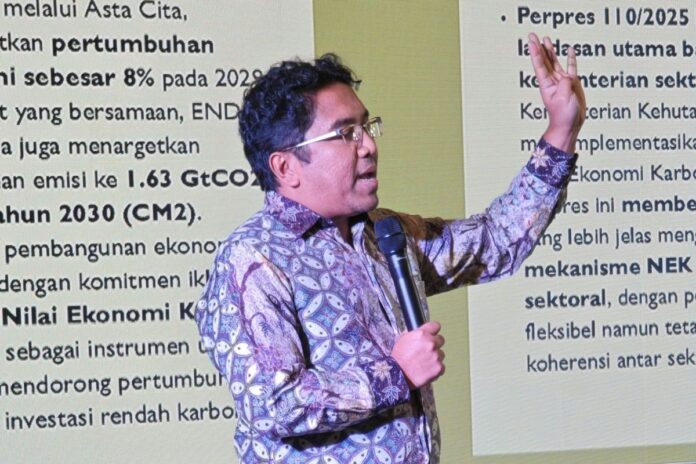
“In early July there will be the first trading activity. The FOLU sector will carry out the transaction. The volume could exceed 30 million tons of emission reductions from existing legacy projects,” Edo said during the Ministerial Dialogue on Climate Change at INVIROTECH 2026 in Jakarta on Thursday (June 11, 2026).
According to Edo, Indonesia’s cross-border carbon trading framework has become more operational following the issuance of Presidential Regulation No. 110/2025 on Carbon Pricing.
To implement the regulation, the Ministry of Forestry has issued Minister of Forestry Regulation No. 6/2026 governing carbon trading procedures in the forestry sector, as well as Regulation No. 7/2026 covering carbon trading mechanisms in conservation areas.
The ministry is also preparing additional regulations governing carbon trading business processes and carbon projects within Indonesia’s social forestry areas.
Edo said the new presidential regulation strengthens coordination across sectors while formally opening Indonesia’s carbon market to international transactions.
Indonesia will provide two trading mechanisms: one through domestically certified emission reductions (SPE) and another through non-certified pathways using international standards and methodologies (Non SPE).
“We are opening both pathways,” he said.
All transactions will be recorded through Indonesia’s Carbon Registry Unit System (SRUK), which is being developed as the country’s central carbon registry platform.
Edo noted that Indonesia has become one of the pilot countries adopting the Common Carbon Credit Data Model developed under the G20 Sustainable Finance Working Group.
The new regulation also enables international carbon trading through corresponding adjustment mechanisms for transferred emission reductions, subject to recommendations from sectoral ministries and approval from the Ministry of Environment.
Indonesia sees major long-term potential in forest-based carbon projects. Edo said the country has around 12 million hectares of degraded land that could be developed into carbon offset projects.
In addition, around 48.7 million hectares of forest areas could support carbon reduction projects through sustainable forest management practices.
Further opportunities also exist within Indonesia’s 8.3 million hectares of social forestry areas and approximately 1.4 million hectares of customary foest. ***