

Indonesia Submits Second NDC to UNFCCC, Sets Clearer, Measurable Climate Goals

MORE ARTICLES

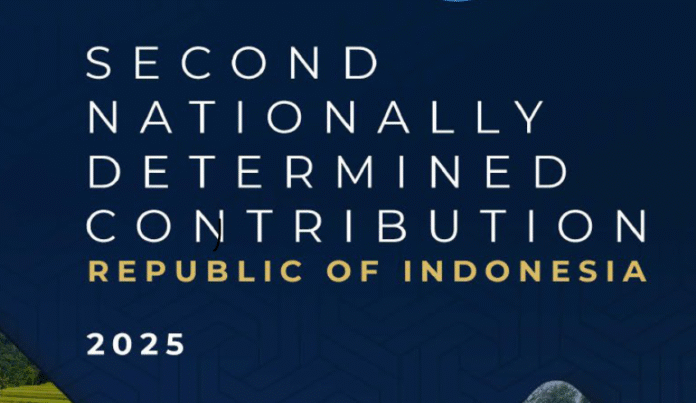
Ecobiz.asia — The Indonesian government has officially submitted its Second Nationally Determined Contribution (Second NDC) to the Secretariat of the United Nations Framework Convention on Climate Change (UNFCCC), reaffirming its long-term commitment to global climate action.

The document marks a major policy shift from a business-as-usual (BAU) baseline to an absolute greenhouse gas (GHG) emission target, using 2019 as the reference year.

In a letter dated October 23, 2025, Deputy for Climate Change and Carbon Governance at the Ministry of Environment and Indonesia’s National Focal Point for the UNFCCC, Ary Sudijanto, said the Second NDC reflects Indonesia’s strengthened ambition and sustained commitment to the global effort to address climate change.

Read also:  Indonesia, Japan Explore Sister Park Initiative to Strengthen National Park Management

“It provides quantifiable information on reference points, timeframes, and implementation approaches, as well as enhanced measures to ensure transparency, inclusivity, and fairness in light of our national circumstances,” Ary wrote in his letter to UNFCCC Executive Secretary Simon Stiell, as seen by ecobiz.asia on Monday (Oct 27, 2025).

Indonesia’s Second NDC replaces percentage-based reduction targets with a more transparent, absolute emission level approach using 2019 as the base year.

The government expects emissions to peak around 1.34–1.49 billion tons of CO₂ equivalent by 2030, before gradually declining toward net-zero emissions by 2060 or earlier.

The Second NDC aligns with Indonesia’s long-term development vision under the National Long-Term Development Plan 2025–2045 (RPJPN) and the Long-Term Strategy for Low Carbon and Climate Resilience (LTS-LCCR 2050), as well as the Asta Cita framework in the 2025–2029 Medium-Term Development Plan (RPJMN).

Read also:  Prabowo Targets 100 GW Solar Buildout, Plans to Phase Out 13 Diesel Power Plants

Several key regulations underpin the implementation, including Government Regulation No. 33/2023 on energy conservation, Presidential Regulation No. 112/2022 on renewable energy acceleration, and Presidential Regulation No. 110/2025 on carbon pricing instruments.

The forestry and land-use (FOLU) sector remains the backbone of Indonesia’s mitigation efforts, targeting FOLU Net Sink 2030, the restoration of 2 million hectares of peatland, and rehabilitation of 8.3 million hectares of degraded land.

The energy sector is directed toward a renewable energy share of 19–23% by 2030 and 70% by 2060.

Read also:  Indonesia Limits Komodo Park Visitors to 1,000 a Day to Curb Overtourism

The Second NDC also emphasizes stronger integration between mitigation and adaptation measures, including through the Climate Village Program (ProKlim), enhancement of the National Registry System (SRN) linked to the Indonesia Stock Exchange for carbon trading, and adoption of the just transition principle to ensure an equitable and inclusive energy transition.

Indonesia estimates total investment needs at about USD 472.6 billion through 2035 to implement the Second NDC, funded partly through the national budget and managed by the Environmental Fund Management Agency (BPDLH). ***


LATEST STORIES

MORE ARTICLES

Chinese National Named Suspect in Smuggling Protected Indonesian Birds Hidden in PVC Pipes

Ecobiz.asia — Indonesia’s Forestry Law Enforcement Agency for the Java, Bali, and Nusa Tenggara region (Jabalnusra) has named a Chinese national, identified as YJ...

BRIN, Japan’s CAST Sign MoU to Develop Sensor Technology for Energy and Manufacturing

Ecobiz.asia — Indonesia’s National Research and Innovation Agency (BRIN) has signed a memorandum of understanding (MoU) with Japan-based technology firm CAST Inc. to develop...

KKP Outlines Blue Carbon Trading Mechanism, Requires Marine Spatial Permit and SRUK Registration

Ecobiz.asia — Indonesia’s Ministry of Marine Affairs and Fisheries (KKP) has outlined the mechanism for blue carbon trading, emphasizing the need to integrate marine...

BEL Valves Secures Multi-Million-Pound Contract for Indonesia’s First CCUS Project

Ecobiz.asia — UK-based valve manufacturer BEL Valves has secured a multi-million-pound contract to supply equipment for Indonesia’s first carbon capture, utilisation and storage (CCUS)...

Indonesia Hosts International Peat Fire Suppression Training with Global Partners

Ecobiz.asia — Indonesia’s Ministry of Forestry has organized an international training program on forest and land fire suppression in peatland ecosystems, involving global partners...

TOP STORIES

NHM Perkenalkan Teknologi DST Plant untuk Dorong Efisiensi dan Kinerja Lingkungan

Ecobiz.asia — PT Nusa Halmahera Minerals (NHM) memperkenalkan inovasi teknologi Dry Stack Tailings (DST) Plant sebagai bagian dari upaya mendorong efisiensi operasional sekaligus meningkatkan...

Dorong Lingkungan Tangguh Bencana, PEP Tarakan Gelar Pelatihan Kebakaran

Ecobiz.asia -- PT Pertamina EP (PEP) Tarakan Field menggelar Sosialisasi dan Edukasi Bencana Kebakaran untuk masyarakat di tiga kelurahan sekitar wilayah operasinya di Kota...

KLH Tempuh Jalur Pidana Kasus Longsor di Bantargebang, Eks Kadis LH DKI Jadi Tersangka

Ecobiz.asia — Kementerian Lingkungan Hidup/Badan Pengendalian Lingkungan Hidup (KLH/BPLH) menegaskan akan menempuh jalur pidana terhadap pelanggaran tata kelola sampah, menyusul kasus longsor di TPST...

Analisis Permenhut 6/2026: Kredit Karbon Kehutanan Siap Masuk Pasar Internasional

Ecobiz.asia - Menteri Kehutanan Raja Juli Antoni secara resmi menetapkan Peraturan Menteri Kehutanan (Permenhut) Nomor 6 Tahun 2026 yang mengatur tata cara perdagangan karbon...

Paradoks Persemaian Kehutanan Indonesia

Oleh: Pramono Dwi Susetyo (Pernah bekerja di Kementerian Lingkungan Hidup dan Kehutanan, Penulis Buku Seputar Hutan dan Kehutanan, dan Membangun Hutan Menjaga Lingkungan) Ecobiz.asia -...