

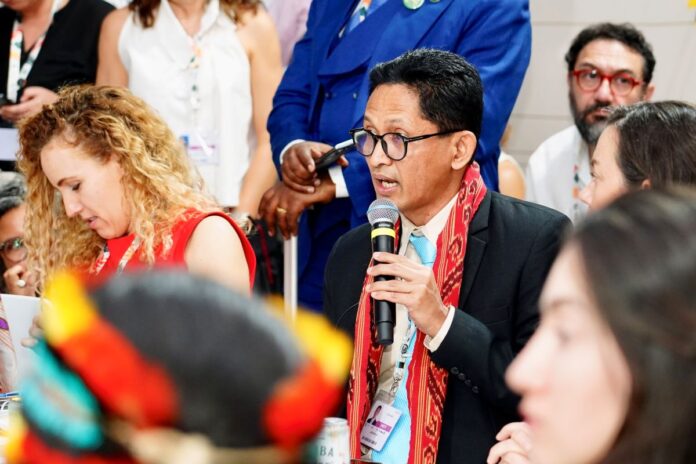
Ecobiz.asia — Indonesia reaffirmed its strong commitment to advancing the recognition and protection of Indigenous Peoples and Local Communities (IPLCs) in global climate action.
The statement was delivered by Julmansyah, Director of Tenure Conflict Resolution and Customary Forests at the Directorate General of Social Forestry, Ministry of Forestry, during a session titled Intergovernmental Land Tenure Commitment Advancing Indigenous Peoples & Local Communities’ Land Tenure held in Action Room 1, Blue Zone COP30 UNFCCC in Belém, Brazil, on Monday (Nov. 17, 2025).
Opening his remarks, Julmansyah expressed appreciation to the organizers and highlighted the Forest and Land Tenure Pledge as an important initiative to strengthen global cooperation in climate action. He underscored the essential role of IPLCs in safeguarding ecosystems and contributing to climate solutions.
“Indigenous Peoples and Local Communities play a critical role in shaping traditional knowledge, sustainable practices, and the stewardship of vital ecosystems, including their significant contribution to climate action,” he said.
Julmansyah outlined Indonesia’s progress in social forestry. As of October 2025, the program has covered more than 8.3 million hectares out of a target of 12.7 million hectares, and benefits over 1.4 million households. Indonesia has also issued 164 customary forest decrees covering 345,257 hectares, managed by 87,963 households.
At COP30, Indonesia officially announced its commitment to accelerating the recognition of customary forests. The Minister of Forestry has set a target to recognize 1.4 million hectares of customary forests within the next four years.
“This bold commitment positions IPLCs as a central pillar of Indonesia’s national climate action,” Julmansyah stressed.
He explained several concrete measures already taken. In March 2025, the Ministry of Forestry established a Special Task Force through Ministerial Decree No. 1440/2025 to accelerate customary forest recognition. The task force operates inclusively with key stakeholders, including Indigenous organizations and NGOs such as AMAN, WALHI, HUMA, JKPP, BRWA, academics, and local governments.
Indonesia is also preparing a national strategic plan, including a roadmap for accelerating customary forest recognition, which is expected to be launched in December 2025.
Additionally, Indonesia is developing collaborative financing mechanisms to support the acceleration of recognition efforts, strengthen information systems, establish an IPLC knowledge directory, and enhance community welfare based on customary territories.
Julmansyah also expressed appreciation to partner countries. “We would like to thank the Government of Norway for its extraordinary support in promoting IPLC development, particularly in accelerating customary forest management,” he said.
He closed by emphasizing the importance of shared leadership and collaboration in climate action. Indonesia, he said, is committed to taking a leading role and welcomes further global cooperation to enhance IPLC engagement.
“Let us move from promises to measurable actions, from commitments to shared outcomes. Together, we can make Belém a turning point in strengthening IPLC roles in climate action,” he concluded. ***