
Ecobiz.asia — Indonesia is stepping up preparations for nuclear power development through strategic cooperation with the United States and Japan, focusing on human capital development, regulatory frameworks, and ecosystem readiness for the safe and sustainable deployment of Small Modular Reactor (SMR) technology.
The initiative is being advanced through the Foundational Infrastructure for Responsible Use of Small Modular Reactor Technology (FIRST) Workshop, held in Jakarta, as part of a trilateral collaboration between Indonesia, the United States, and Japan to strengthen the country’s nuclear power foundation.
Secretary-General of the National Energy Council (DEN) Dadan Kusdiana, representing Indonesia’s Vice Minister of Energy and Mineral Resources, said the cooperation is aimed at strengthening human resource capacity, enhancing SMR design and regulatory frameworks, upgrading high-technology manufacturing capabilities, and ensuring the application of world-class nuclear safety and security standards.
“This synergy ensures Indonesia can develop and utilize nuclear power responsibly, with the highest safety standards, transparent governance, and well-prepared human resources,” Dadan said on Wednesday (March 4, 2026).
He noted that nuclear energy offers a stable, low-emission power supply capable of supporting long-term economic growth. Advances in SMR technology, he added, have made nuclear development more adaptive and increasingly relevant for developing economies.
Dadan said Indonesia, alongside Southeast Asia’s major energy consumers—Malaysia, the Philippines, Thailand, and Vietnam—is actively exploring nuclear energy options while strengthening regional cooperation through the Nuclear Energy Cooperation Sub-Sector Network (NEC-SSN).
The initiative aligns with Government Regulation No. 40/2025 on the National Energy Policy, which positions nuclear power as part of Indonesia’s long-term strategy to safeguard energy security and support national economic growth targets.
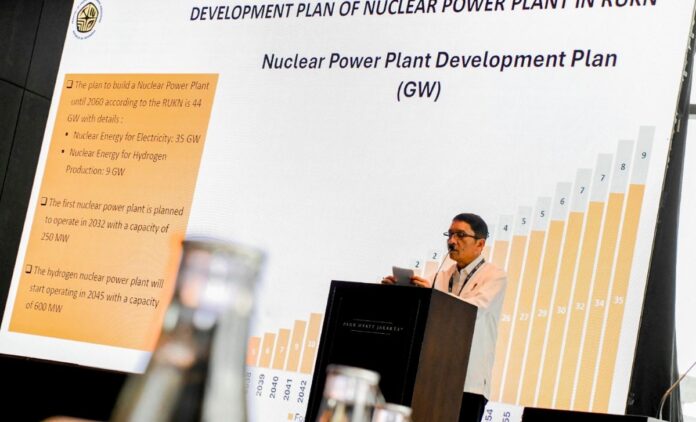
Under the policy, nuclear energy is projected to contribute around 11.7–12.1% of Indonesia’s primary energy mix by 2060, with installed capacity estimated at 35–42 gigawatts (GW). As an initial step, Indonesia plans to bring its first nuclear power plant into commercial operation by 2032 with an initial capacity of 250 megawatts (MW), as outlined in the 2025–2034 Electricity Supply Business Plan (RUPTL).
Beyond decarbonisation goals, nuclear power is being considered for its land-use efficiency and relatively competitive long-term operating costs.
U.S. Embassy Chargé d’Affaires Peter M. Haymond said the United States, together with Japan, is honoured to serve as a trusted partner in supporting Indonesia’s safe and responsible nuclear energy development. He said U.S. technology and experience could help Indonesia build a resilient and reliable energy system.
Meanwhile, Japanese Embassy Chargé d’Affaires Mitsuru Myochin reaffirmed Japan’s commitment to supporting Indonesia’s energy transition under the Asia Zero Emission Community (AZEC) framework. Japan is ready to share its experience in enhancing safety standards, transparency, and nuclear human resource development through technical cooperation among policymakers, regulators, and industry players.
The FIRST Workshop was organised by the National Energy Council in collaboration with Institut Teknologi PLN and Masyarakat Energi Terbarukan Indonesia, and supported by the U.S. Department of State’s FIRST Program, Advanced Systems Technology & Management (AdSTM), The Association for Overseas Technical Cooperation and Sustainable Partnerships (AOTS), and JAIF International Cooperation Center (JICC).
The forum brought together policymakers, academics, industry players, and nuclear experts to discuss key aspects of nuclear power development, including SMR technology, regulatory and licensing frameworks, human resource development, and opportunities for domestic industry participation. ***