
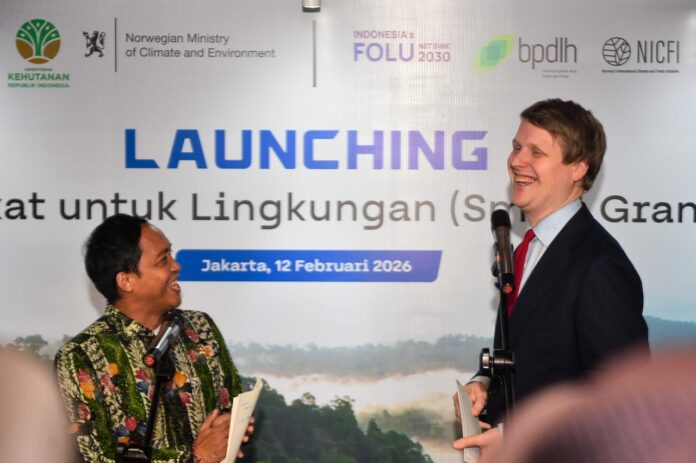
Ecobiz.asia — The governments of Indonesia and Norway have launched the fourth phase of the Community-Based Environmental Funding Facility (Small Grant) to strengthen public participation in forestry-related climate action under Indonesia’s Forestry and Other Land Use (FOLU) Net Sink 2030 agenda.
The programme was officially launched by Indonesia’s Minister of Forestry Raja Juli Antoni and Norway’s Minister of International Development Asmund Aukrust in Jakarta on Thursday (February 12, 2026).
Funding for the Small Grant facility is provided through Indonesia–Norway cooperation under a Result-Based Contribution (RBC) mechanism, channelled by the Ministry of Forestry through the Environmental Fund Management Agency (BPDLH).
“On behalf of the Government of Indonesia, we express our appreciation to the Government of Norway for the strong cooperation through this results-based financing mechanism,” Raja Juli Antoni said.
He underscored that climate change and global warming pose real and urgent challenges, while the window for mitigation action is increasingly limited. As such, results-based international collaboration needs to be further strengthened.
The Community-Based Environmental Funding Facility is designed as a financing instrument to actively and inclusively engage communities in environmental protection and climate resilience efforts.
Beneficiaries include a wide range of civil society groups, from youth organisations and social forestry groups to conservation and environmental advocates.
Over the first three phases, the programme has disbursed Rp19.31 billion to 561 community groups, reaching a total of 31,512 beneficiaries across 36 provinces.
For the fourth phase, the government has allocated Rp7 billion, targeting around 200 grant recipients. The call for proposals is open from February 12 to 19, 2026, with a simplified application process. Proposals can be submitted online via layanan-dana-masyarakat.bpdlh.id.
Applicants may choose from three thematic areas: FOLU Goes to School, focusing on youth engagement in environmental protection; FOLU Terra, aimed at improving community livelihoods through environment-based activities; and FOLU Biodiversity, supporting biodiversity conservation.
Through this scheme, the Ministry of Forestry is opening broad opportunities for public participation to support climate mitigation efforts and reinforce Indonesia’s commitment to achieving FOLU Net Sink 2030.
Meanwhile, Norway’s Minister of International Development Asmund Aukrust welcomed Indonesia’s commitment to community involvement in climate action, stressing that climate change is a global crisis that no country can tackle alone.
“No country can solve climate change on its own. That is why partnerships such as the one between Norway and Indonesia are critically important,” Aukrust said.
He noted that Norway has so far contributed US$216 million in recognition of Indonesia’s achievements in reducing deforestation under the Result-Based Contribution mechanism. According to him, the fourth phase of the Small Grant programme demonstrates that international support must reach communities living closest to forests.
“We are proud of the partnership and friendship with Indonesia. We are here to listen, to learn, and to reaffirm that we are in this fight together,” he said. ***