

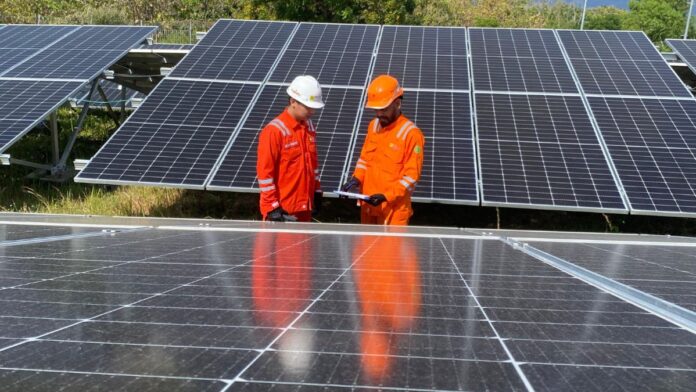
Ecobiz.asia – Indonesia is looking to international climate finance and private capital to help turn its 100 GW solar ambition into investment projects, as the government seeks to reduce diesel dependence while limiting pressure on public finances.
The planned 100 GW solar program could save around Rp21.24 trillion in diesel costs, contribute Rp112.4 trillion to regional gross domestic product and create an estimated 118,000 green jobs, according to figures presented by the Ministry of Finance.
Irwan Dharmawan of the Ministry of Finance’s Directorate of Multilateral Cooperation and Sustainable Finance presented the estimates during Indonesia Sustainable Energy Week (ISEW) 2026 on Thursday (August 20, 2026).
The program could also avoid around 24.3 million tonnes of CO2 equivalent emissions by using solar and battery systems to replace diesel generation, particularly in areas where fuel-based electricity remains expensive.
The economic case for the solar program comes as Indonesia faces a significant financing challenge for its broader energy transition. The Ministry of Finance estimates average annual central-government climate spending at around Rp73.5 trillion between 2018 and 2024, equivalent to about 3% of the state budget.
Only 12.9% of estimated mitigation financing needs in the comparison presented by the ministry were covered by the state budget, highlighting the need for international and private capital to finance the transition.
The Green Climate Fund (GCF) is among the international financing sources being used to help close that gap. As of August 2026, Indonesia’s GCF portfolio comprised 22 projects, including five single-country projects and 17 multi-country programs.
The GCF has allocated around US$612 million (Rp10.92 trillion) to projects involving Indonesia, with another US$2.4 billion (Rp42.83 trillion) in co-financing mobilised alongside the fund.
The portfolio could reach around 26 million beneficiaries and contribute to about 400 million tonnes of CO2 equivalent in emissions reductions, although the ministry noted that the impact attributed to Indonesia from multi-country programs is based on indicative data.
Indonesia’s GCF portfolio includes the Geothermal Resource Risk Mitigation (GREM) program and initiatives supporting industrial energy-efficiency financing. The country is also participating in multi-country programs supporting renewable energy, including the Sustainable Renewables Risk Mitigation Initiative, Climate Investor One and the ASEAN Catalytic Green Finance Facility’s Green Recovery Program.
The government is positioning GCF and other international climate finance as catalytic capital rather than a substitute for commercial investment. Other sources include multilateral development banks, international financial institutions, bilateral partners, private investment, sustainable bank lending, capital markets, carbon markets, philanthropy and state-owned enterprises.
For the 100 GW solar program, the Ministry of Finance sees the economic benefits extending beyond electricity generation. A larger solar market could stimulate investment in solar modules, battery storage, engineering, procurement and construction services, operations and maintenance, financing and supporting grid infrastructure.
The economics of replacing diesel are also becoming more attractive as battery costs decline. The ministry’s presentation showed that solar PV combined with battery storage is already competitive with standalone diesel generation in several parts of Indonesia.
The cost advantage is particularly relevant in remote areas, where fuel transportation and diesel operating costs can make electricity generation significantly more expensive. Replacing diesel with solar and storage could therefore reduce fuel consumption while improving energy security and easing pressure on public finances.
The scale of the financing challenge means the government will need to mobilise capital beyond the state budget. For renewable projects, the Ministry of Finance sees international climate finance as one mechanism for reducing project risks and attracting additional commercial financing.
The 100 GW ambition will therefore depend not only on the volume of solar capacity planned, but also on Indonesia’s ability to use climate finance to develop bankable projects and mobilise larger pools of private capital. ***