
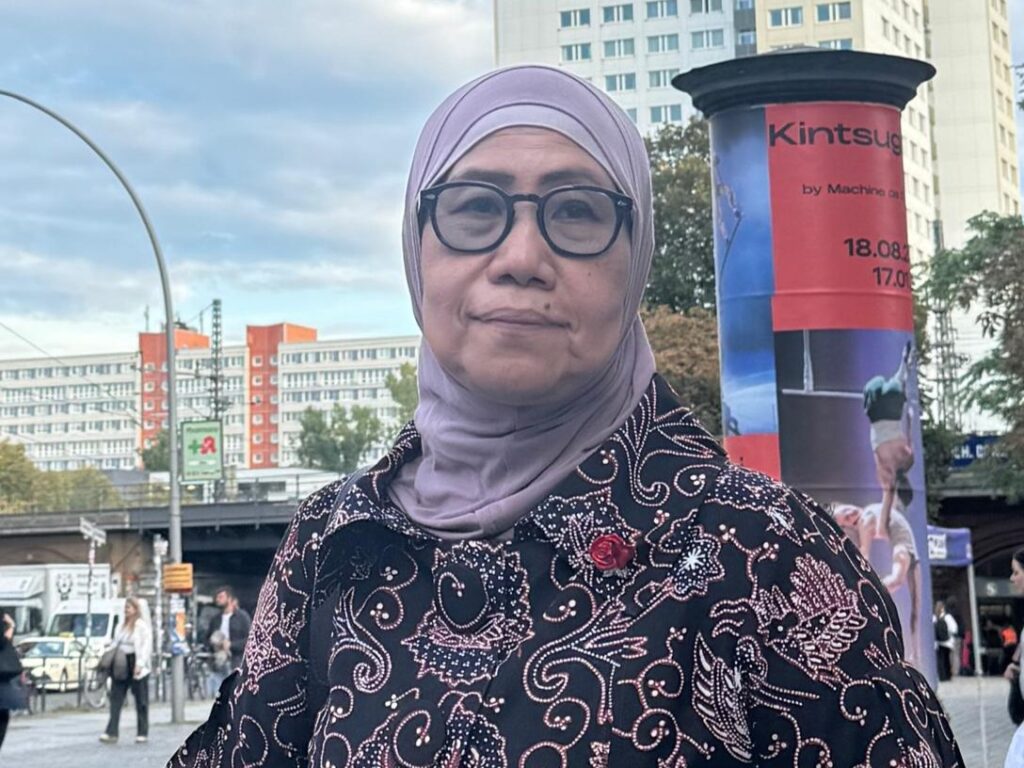
By Diah Suradiredja (Sustainable Commodity Trade Observer)
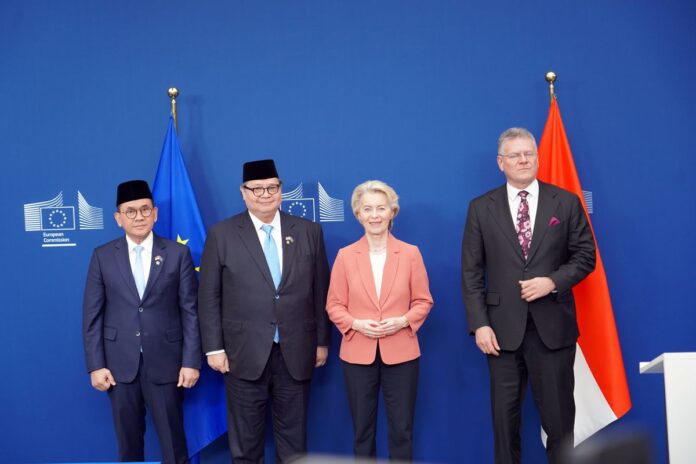
Ecobiz.asia – After nearly ten years of negotiations, Indonesia and the European Union (EU) finally signed the Comprehensive Economic Partnership Agreement (IEU-CEPA) and the Investment Protection Agreement (IPA) on 21 November 2026. It has been a long journey. Since negotiations began in 2016, both sides have gone through changes in political leadership, the COVID-19 pandemic, geopolitical tensions, and significant shifts in global trade policies.
The signing of these agreements deserves recognition. At a time when global economic relations are becoming increasingly uncertain and fragmented, Indonesia and the EU have chosen to strengthen their economic partnership. For Indonesia, IEU-CEPA offers opportunities to expand market access, improve export competitiveness, attract investment, and strengthen its position in global value chains. For the EU, the agreement provides an opportunity to diversify its supply chains and deepen economic relations with one of Asia’s largest economies.
Much of the public discussion has understandably focused on tariff reductions, export opportunities, and potential investment. For me, there is a more fundamental question that deserves our attention:
Is Indonesia ready to turn better market access into meaningful economic transformation and stronger environmental governance?
Trade agreements create opportunities. They do not automatically deliver better development outcomes. The ability to benefit from these opportunities depends on the readiness of our industries, the strength of our institutions, the quality of our natural resource governance, and the capacity of businesses to respond to changing market requirements.
IEU-CEPA should be seen as the beginning of a much larger undertaking. Indonesia needs to look beyond gaining access to the European market and consider how this agreement can strengthen the domestic economy, improve environmental governance, and create opportunities for a wider range of economic actors.
When Trade Becomes More Than Just Tariffs
When IEU-CEPA negotiations began in 2016, international trade discussions were still largely focused on tariffs, market access, technical barriers, services, and investment protection. Ten years later, the landscape has changed considerably. Trade is increasingly connected to climate change, biodiversity loss, the energy transition, workers’ rights, and the growing demand for transparency in global supply chains.
We can see this shift in several EU policies, including the EU Deforestation Regulation (EUDR), which introduces requirements on deforestation-free production, legality, and due diligence for certain commodities and products entering or exported from the EU market. Indonesia now faces two realities. IEU-CEPA offers better market access through tariff reductions and greater certainty in economic relations. Access to the European market also requires Indonesian producers and businesses to meet applicable regulatory and sustainability requirements.
Lower tariffs do not mean fewer environmental obligations. IEU-CEPA does not automatically exempt Indonesian products from the EUDR, which has its own legal basis and implementation mechanisms. This is where I believe Indonesia-EU trade relations need to be understood from a broader perspective. It would be too simplistic to treat every sustainability requirement as a trade barrier. It would also be unrealistic to expect producing countries to meet increasingly complex requirements without sufficient investment, institutional capacity, technology, and support for businesses.
Sustainability standards can encourage improvements in production practices and supply chain governance. When these standards are introduced without sufficient consideration of the conditions in producing countries, the cost of compliance can become disproportionately high, particularly for small producers. If Indonesia and the EU share a commitment to sustainable trade, that commitment needs to be reflected in the way they work together.
Setting standards is one part of the process. Building the capacity to meet those standards is equally important. This should become an important part of the economic partnership between Indonesia and the EU.
Market Access Requires Credible National Systems
Indonesia is not starting from zero. Over the years, Indonesia has developed various instruments to support legal and sustainable production. In the forestry sector, we have the Timber Legality and Sustainability Verification System (SVLK). In the palm oil sector, we have the Indonesian Sustainable Palm Oil (ISPO) certification scheme.
We also have licensing systems, environmental monitoring mechanisms, geospatial information systems, and various certification arrangements. These are important foundations. The challenge is how to connect them and ensure that the information they provide is consistent, reliable, and can be verified.
A certificate alone may not answer every market requirement. A legal document does not necessarily demonstrate that a product is deforestation-free. Geolocation data has limited value if it cannot be linked to producers, suppliers, transactions, and the products being traded. What Indonesia needs is a credible system that can demonstrate where products come from, their legal status, the quality of the supporting information, the risks identified, and how those risks are addressed.
This is not simply a technical issue of collecting more data. It is also a governance issue involving institutional mandates, coordination between government agencies, common data standards, and clear arrangements for sharing information. Indonesia does not necessarily need another large digital platform. What matters is whether the systems we already have can communicate with each other and produce information that is reliable and accountable.
In the context of IEU-CEPA, strengthening these national systems should become a strategic priority. The benefits would extend well beyond compliance with European market requirements. Reliable national systems can strengthen domestic oversight, improve business certainty, support better natural resource management, and reduce risks throughout our supply chains.
We should use the growing demand for sustainability and transparency in international markets as an opportunity to improve our own governance.
We need to move beyond simply meeting market requirements and build national systems that make compliance possible, verifiable, and inclusive.
Trade Diplomacy Must Be Supported by Domestic Reform
Indonesia-EU trade relations have not always been free from disagreements. Commodity policies, environmental requirements, and market access have been part of bilateral discussions and, at times, trade disputes. This is understandable. Indonesia and the EU have different economic interests, development circumstances, and regulatory approaches.
Indonesia wants to maintain market access, protect the competitiveness of its products, and ensure that international trade requirements do not become disproportionate barriers. The EU wants to ensure that products entering its market comply with its regulations and environmental commitments.
I do not see these interests as necessarily being in conflict. IEU-CEPA provides an opportunity to develop a more constructive and structured dialogue on sustainability standards, national systems, technical cooperation, and supply chain readiness.
For Indonesia, this requires a stronger evidence-based approach to trade diplomacy. Expressing concerns about particular regulations is important. We also need to demonstrate what our national systems can deliver, acknowledge the gaps that remain, and propose practical solutions.
In the context of the EUDR, for example, Indonesia could encourage more technical discussions on the use of national data as supporting evidence, the interoperability of information systems, the quality of geolocation data, and ways to reduce unnecessary duplication in verification processes.
The use of national evidence would still need to comply with EU regulations and would not replace the due diligence responsibilities of the relevant operators. At the domestic level, Indonesia needs stronger coordination among government institutions. Our negotiating position will be stronger when supported by credible information, consistent policies, and clear institutional responsibilities.
There are limits to what diplomacy can achieve when the underlying problems require improvements in domestic governance. Domestic reform also needs international cooperation, particularly when changing market requirements demand new investment in technology, institutional capacity, and financing.
This is where I see the wider value of IEU-CEPA. It can become a framework for cooperation that helps both sides move towards more sustainable trade, rather than simply a mechanism for negotiating market access.
Ensuring Market Openness Does Not Widen Inequality
One question that should always be asked when discussing a trade agreement is: who will benefit? Large companies with sufficient capital, technology, administrative capacity, and access to information are generally better prepared to take advantage of new market opportunities. They can adjust their production systems, respond to buyer requirements, and manage compliance risks relatively quickly.
The situation is very different for small businesses, cooperatives, independent smallholders, and local producers. In many of Indonesia’s commodity supply chains, small producers still face difficulties in obtaining legal documents, accessing geospatial information, financing certification, and responding to increasingly complex information requirements from international buyers.
These difficulties should not automatically be interpreted as evidence of non-compliance. In many cases, small producers simply do not have access to the institutional support and services needed to demonstrate their compliance.
If the cost of adjustment is left entirely to small producers, greater market openness may widen the gap between those who are already prepared and those who still need support. Companies may find it easier to source from suppliers with complete documentation. Smallholders who have adopted responsible production practices could still lose access to formal supply chains simply because they cannot provide the required evidence.
This is a risk that Indonesia and the EU need to address in the implementation of IEU-CEPA. An inclusive trade policy cannot stop at providing export opportunities for small businesses. It must also create the conditions that allow them to benefit from those opportunities.
Practical support is needed to strengthen producer organisations, improve access to legal documentation, provide land mapping services, develop shared traceability systems, and make compliance financing more accessible. Governments, large companies, international buyers, and financial institutions all have a role to play. The responsibility for building sustainable supply chains should not be placed entirely on those with the least resources.
The same principle applies to Indigenous Peoples and local communities. Their role should go beyond being beneficiaries of economic development programmes. Their rights, representation, and participation need to be recognised in decisions affecting their territories, natural resources, and livelihoods.
Inclusive trade is not simply about opening markets. It is about ensuring that more people have the capacity to enter those markets, participate, and remain competitive.
Investment Must Improve the Quality of Development
IEU-CEPA should also be viewed alongside the Investment Protection Agreement (IPA), which reflects the importance of investment certainty and protection in Indonesia-EU economic relations. Indonesia needs investment to strengthen its industries, improve productivity, develop technology, and create employment. The EU has an interest in expanding its investment partnerships and building more diversified and resilient supply chains.
There are significant opportunities for cooperation in the energy transition, higher-value manufacturing, infrastructure, and the development of a low-carbon economy. The question is what kind of investment Indonesia wants to attract.
An increase in investment does not always translate into better development outcomes. Expanding production without considering environmental carrying capacity can create additional pressure on natural ecosystems. Investment that fails to address land tenure issues and community rights can also create significant social costs.
For this reason, we need to assess investment beyond the amount of capital entering the country. We should also look at where the capital goes, what economic activities it supports, what risks it creates, and what changes it brings to the economy, the environment, and society.
Indonesia-EU investment cooperation could support cleaner technology, resource efficiency, sustainable productivity, waste management, ecosystem restoration, and improvements in industrial capacity to meet environmental and social standards.
Financial institutions have an important role in this process. Environmental and social risks need to be considered from the beginning of an investment assessment, not after financing decisions have already been made.
Efforts to improve investment certainty must go hand in hand with transparency, accountability, environmental protection, and respect for community rights. The opportunity offered by IEU-CEPA and the IPA is not only to increase the flow of investment. It is also to improve the quality of the economic activities being financed.
From a Trade Agreement to a National Transformation Agenda
With the signing of IEU-CEPA, Indonesia’s work is far from over. The agreement still needs to go through the necessary approval and entry-into-force procedures. This period should be used to prepare a clear national implementation agenda. There are at least five areas that deserve particular attention.
First, understanding sectoral readiness. Indonesia needs to identify which sectors and value chains are best positioned to benefit from IEU-CEPA, while understanding the gaps that may prevent others from taking advantage of the agreement. This assessment should cover large industries, small businesses, cooperatives, and primary producers.
Second, strengthening national governance systems. Legality, sustainability, and traceability should become cross-sector priorities. Institutions responsible for trade, industry, investment, agriculture, forestry, the environment, standardisation, and data management need to work within a coherent framework, with clear responsibilities and practical coordination mechanisms.
Third, developing a more practical Indonesia-EU cooperation agenda. Policy dialogue needs to lead to joint programmes that address the actual challenges faced by producers and businesses. These could include capacity building, technology development, data quality improvement, transition financing, and targeted support for small producers.
Fourth, improving the quality of investment. Investment facilitation and incentives should be directed towards activities that improve productivity, encourage innovation, use natural resources more efficiently, protect the environment, and create wider economic benefits.
Fifth, monitoring the benefits and impacts of the agreement. Export growth and investment value will remain important indicators. They should not be the only measures of success. We also need to look at improvements in productivity, small business participation, employment quality, environmental compliance, ecosystem conditions, and the distribution of economic benefits across supply chains.
These priorities require strong national leadership and coordination. A trade agreement provides a framework for cooperation between countries. The transformation itself will depend on the decisions we make at home, the institutions responsible for implementing those decisions, and our ability to translate policy commitments into practice.
Ten Years of Negotiations, but the Real Test Lies in Implementation
The signing of IEU-CEPA marks an important achievement in Indonesia’s economic diplomacy. It creates new opportunities for Indonesia and the EU to strengthen their partnership at a time of significant global change.
We should recognise this achievement without assuming that all trade-related challenges have been resolved. We should also be careful not to see environmental and sustainability requirements only as obstacles to economic growth.
Market openness and environmental sustainability can support each other when backed by credible governance, consistent policies, and a fair distribution of responsibilities. For Indonesia, perhaps one of the greatest benefits of IEU-CEPA is the opportunity it creates to reform our economic systems and natural resource governance, two areas that have too often been managed separately.
For the EU, the agreement offers an opportunity to demonstrate that sustainable trade can be built through genuine partnerships. Producing countries need to be supported in meeting sustainability requirements, not simply expected to adjust to standards set elsewhere.
After nearly ten years of negotiations, our attention should now move beyond what Indonesia and the EU have agreed upon. What will actually change once the agreement is implemented? Will Indonesia be able to create greater domestic value and strengthen national competitiveness? Will investment improve productivity while protecting the environment? Will our systems for legality, sustainability, and traceability become more credible? Will small producers and local communities have a fairer share of the economic benefits?
These are the questions that will ultimately determine the value of IEU-CEPA for Indonesia.
Trade agreements open doors. The quality of our governance determines who can walk through those doors, and our national policies determine what happens next.
It has taken nearly ten years to reach this agreement. The years ahead will tell us whether Indonesia can turn the opportunity of market access into meaningful economic transformation, stronger environmental governance, and more inclusive development.
That, for me, is the real test of IEU-CEPA. ***
Disclaimer: This article reflects the author’s personal views and opinions. The content is entirely the author’s responsibility and does not necessarily represent the views or positions of the Ecobiz.asia editorial team.