
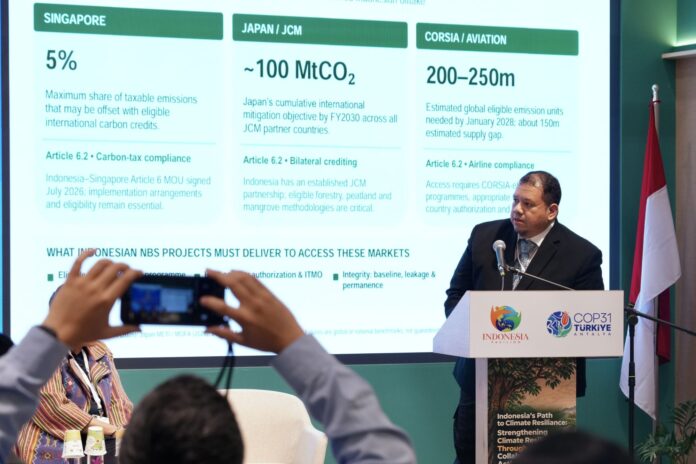
Ecobiz.asia – Indonesia is targeting international compliance carbon markets under Article 6 of the Paris Agreement to unlock the potential of its forestry and nature-based solutions (NbS) sectors, with potential demand coming from Singapore, Japan and the international aviation scheme ICAO-CORSIA.
Laksmi Wijayanti, director general of sustainable forest management at Indonesia’s Ministry of Forestry, said access to international markets would depend on the availability of high-integrity carbon credits, supported by transparent accounting, safeguards against double counting and clear governance.
“Carbon transactions from the forestry sector through Article 6 require clear governance, credible accounting, environmental and social safeguards, transparent reporting, and commercially viable schemes for investors and buyers,” Laksmi said at a panel discussion titled “High-Integrity Forest Carbon: Indonesia’s Pathway under Article 6” at the Indonesia Pavilion during COP31 in Antalya on Friday (Nov. 13, 2026
She cited BloombergNEF 2025 data estimating Indonesia’s forest carbon potential at 13.4 gigatonnes of CO₂.
Ilham, director of forest utilisation business development at the Ministry of Forestry, outlined opportunities to commercialise forest carbon credits through market-based mechanisms under Article 6.2 and Article 6.4 of the Paris Agreement, as well as non-market approaches under Article 6.8.
He said demand for nature-based carbon credits under Article 6.2 was significant, particularly from Singapore, Japan’s Joint Crediting Mechanism (JCM) and ICAO-CORSIA.
“Singapore currently allows the use of international carbon credits to offset up to 5% of the taxable emissions of Singapore-based companies,” Ilham said.
Japan’s JCM, meanwhile, has a cumulative international mitigation target of around 100 million tonnes of CO₂ by 2030 across all partner countries. Indonesia is pursuing closer cooperation with Japan under the mechanism, with peatlands and mangroves among the areas being considered to differentiate Indonesia’s project portfolio from those of other JCM partner countries.
Another potential source of demand is ICAO-CORSIA, the Carbon Offsetting and Reduction Scheme for International Aviation. Ilham said the scheme was estimated to require 200 million to 250 million eligible carbon units through January 2028.
To support market access, Indonesia has established a regulatory framework through Presidential Regulation No. 110/2025 and Forestry Ministerial Regulation No. 6/2026. The rules cover the authorisation of international transfers of mitigation outcomes (ITMOs) and technical procedures for carbon trading in the forestry sector.
“Indonesia has prepared regulations to support carbon trading under Article 6 of the Paris Agreement, including provisions on the authorisation of mitigation outcome transfers and the prevention of double counting,” Ilham said.
Win Sim Tan, Verra’s regional representative for Asia and the Pacific, said using existing carbon methodologies could accelerate project development, as governments would not need to develop new methodologies from scratch. He cited several Verra methodologies accepted by Singapore, including those covering REDD+, afforestation and forest protection.
Andrea Bonzanni, director of international policy at the International Emissions Trading Association (IETA), said Indonesia needed to balance international carbon credit transfers with its ability to meet its national climate targets under its nationally determined contribution (NDC).
He also urged Indonesia to engage closely in technical discussions on Article 6.4 at COP31, particularly on issues such as permanence, standard methodologies and tools. He noted that the draft discussions under the Paris Agreement’s CMA had yet to adequately address the forestry sector.
Eron Bloomgarden, CEO of Emergent, said forest-rich countries needed long-term demand certainty to support the supply of carbon credits, while buyers required confidence that sufficient credits would be available.
Kuki Soejachmoen, executive director of the Indonesia Research Institute for Decarbonization (IRID), also spoke at the panel. ***