

Ecobiz.asia — ASEAN member states have agreed to accelerate efforts to control invasive alien species (IAS) through a new regional initiative aimed at curbing biodiversity loss across the region.
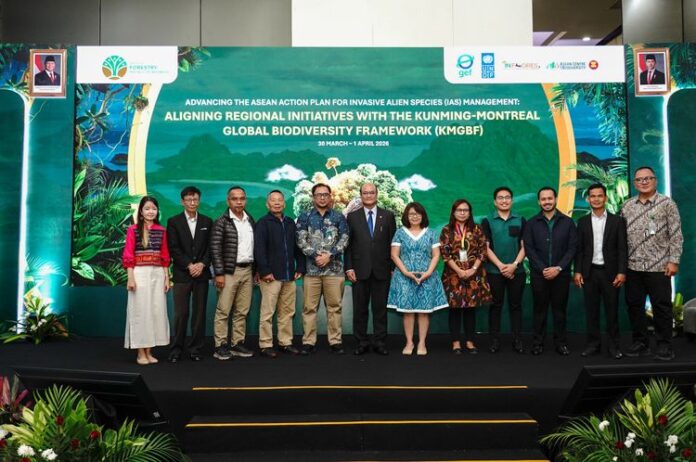
The agreement was reached during the “Advancing the ASEAN Action Plan for Invasive Alien Species (IAS) Management” workshop held in Jakarta from March 30 to April 1, 2026, involving the ASEAN Centre for Biodiversity, the ASEAN Secretariat, member states, and development partners.
The initiative, known as Accelerating IAS Management in ASEAN (AIM-ASEAN), is designed to strengthen regional coordination, biosecurity systems, early detection mechanisms, technical capacity, and sustainable financing for cross-border invasive species management.
Director General of Natural Resources and Ecosystem Conservation (KSDAE) at Indonesia’s Forestry Ministry, Satyawan Pudyatmoko, said invasive species are responsible for around 60% of global extinctions, with island ecosystems such as those in ASEAN particularly vulnerable.
“ASEAN’s islands are rich in biodiversity but highly susceptible to the introduction and spread of invasive species,” he said.
Through AIM-ASEAN, member states aim to contribute to the Kunming-Montreal Global Biodiversity Framework, particularly Target 6, which seeks to reduce the rate of invasive species introduction and spread by 50% by 2030.
The program will cover six key components, including strengthening governance and regional coordination, integrating data and early warning systems, enhancing biosecurity and risk assessment, building technical capacity, implementing pilot projects, and developing sustainable financing mechanisms.
Indonesia has proposed Komodo National Park as one of the pilot sites, positioning it as a model for invasive species control that could be replicated in other protected areas across the region.
ASEAN also plans to establish a regional clearing house mechanism, a watchlist system, and strengthened early detection and rapid response protocols to address transboundary threats.
The outcomes of the workshop will be formulated into a project concept note to be submitted to global funding mechanisms, including the Global Biodiversity Framework Fund and the Global Environment Facility.
Satyawan said AIM-ASEAN represents a concrete regional step to strengthen biodiversity protection and ecological resilience amid rising pressures from trade, transport, and tourism. ***