

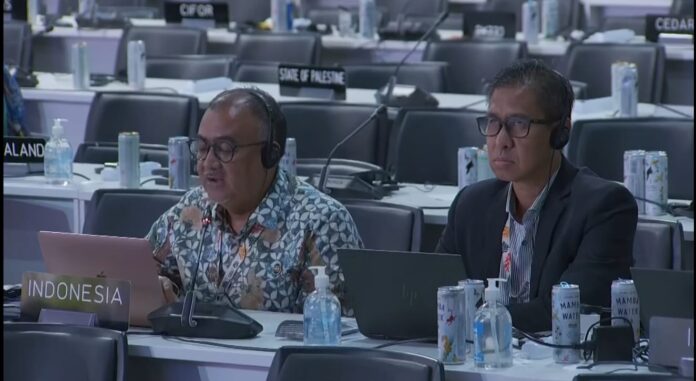
Ecobiz.asia — Indonesia called on countries to move beyond political pledges and step up real climate action as the UN COP30 climate summit concluded in Belém after two weeks of negotiations.
The Indonesian delegation, led by the Ministry of Environment and the Environmental Control Agency (KLH/BPLH), said developing nations cannot deliver on climate targets without predictable finance, technology transfer and capacity-building support.
“Implementation without real support is merely rhetoric. We need grant-based finance, accessible technology and fair mechanisms to turn commitments into action,” said Ary Sudijanto, Deputy for Climate Change Control and Carbon Economic Value Governance on Sunday (Nov. 23, 2025)
Indonesia pressed for simple, measurable and flexible indicators under the Global Goal on Adaptation (GGA) to avoid creating administrative burdens for developing countries. Jakarta also urged negotiators to prioritise finalising practical indicators before expanding discussions into new terminology such as “transformational adaptation”, which it said risked adding complexity.
The delegation welcomed the adoption of the Belem Gender Action Plan (2026–2034) but underscored that its implementation must align with national processes and domestic laws.
Reform of Climate Finance
Indonesia renewed calls to reform global climate finance architecture, warning that developing countries face growing climate risks while access to finance remains slow and often loan-based.
Jakarta reiterated its support for a global climate finance target of US$1.3 trillion per year by 2035, including at least US$300 billion for developing nations, and for scaling up adaptation finance to US$120 billion annually by 2030.
On carbon markets under Article 6 of the Paris Agreement, the country highlighted the need for stronger technical support for international registries and a smooth transition of Clean Development Mechanism (CDM) projects to maintain market integrity.
Environment Minister and KLH/BPLH Head Hanif Faisol Nurofiq said decisions taken in Belém must translate into real benefits for vulnerable communities.
“COP30 decisions must protect people, strengthen national resilience and ensure that the transition to a low-carbon economy is just, inclusive and sustainable,” Hanif said. ***