

Indonesia Submits Second NDC to UNFCCC, Sets Clearer, Measurable Climate Goals

MORE ARTICLES

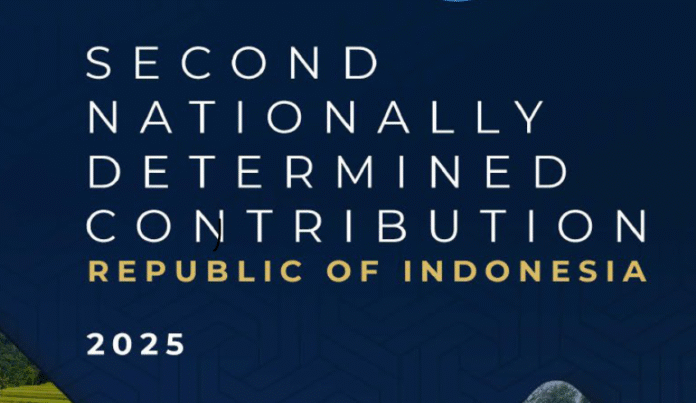
Ecobiz.asia — The Indonesian government has officially submitted its Second Nationally Determined Contribution (Second NDC) to the Secretariat of the United Nations Framework Convention on Climate Change (UNFCCC), reaffirming its long-term commitment to global climate action.

The document marks a major policy shift from a business-as-usual (BAU) baseline to an absolute greenhouse gas (GHG) emission target, using 2019 as the reference year.

In a letter dated October 23, 2025, Deputy for Climate Change and Carbon Governance at the Ministry of Environment and Indonesia’s National Focal Point for the UNFCCC, Ary Sudijanto, said the Second NDC reflects Indonesia’s strengthened ambition and sustained commitment to the global effort to address climate change.

Read also:  ITS, Swedish Embassy Eye Expanded Education and Research Collaboration

“It provides quantifiable information on reference points, timeframes, and implementation approaches, as well as enhanced measures to ensure transparency, inclusivity, and fairness in light of our national circumstances,” Ary wrote in his letter to UNFCCC Executive Secretary Simon Stiell, as seen by ecobiz.asia on Monday (Oct 27, 2025).

Indonesia’s Second NDC replaces percentage-based reduction targets with a more transparent, absolute emission level approach using 2019 as the base year.

The government expects emissions to peak around 1.34–1.49 billion tons of CO₂ equivalent by 2030, before gradually declining toward net-zero emissions by 2060 or earlier.

The Second NDC aligns with Indonesia’s long-term development vision under the National Long-Term Development Plan 2025–2045 (RPJPN) and the Long-Term Strategy for Low Carbon and Climate Resilience (LTS-LCCR 2050), as well as the Asta Cita framework in the 2025–2029 Medium-Term Development Plan (RPJMN).

Read also:  Indonesia, Malaysia Strengthen Commitment to Cross-Border Wildlife Protection

Several key regulations underpin the implementation, including Government Regulation No. 33/2023 on energy conservation, Presidential Regulation No. 112/2022 on renewable energy acceleration, and Presidential Regulation No. 110/2025 on carbon pricing instruments.

The forestry and land-use (FOLU) sector remains the backbone of Indonesia’s mitigation efforts, targeting FOLU Net Sink 2030, the restoration of 2 million hectares of peatland, and rehabilitation of 8.3 million hectares of degraded land.

The energy sector is directed toward a renewable energy share of 19–23% by 2030 and 70% by 2060.

Read also:  MoF Strengthens Science Based Forestry Cooperation With CIRAD to Support Climate Change Action

The Second NDC also emphasizes stronger integration between mitigation and adaptation measures, including through the Climate Village Program (ProKlim), enhancement of the National Registry System (SRN) linked to the Indonesia Stock Exchange for carbon trading, and adoption of the just transition principle to ensure an equitable and inclusive energy transition.

Indonesia estimates total investment needs at about USD 472.6 billion through 2035 to implement the Second NDC, funded partly through the national budget and managed by the Environmental Fund Management Agency (BPDLH). ***


LATEST STORIES

MORE ARTICLES

Survey Shows Danantara’s Stabilisation Potential, Governance and Strategy Under Scrutiny

Ecobiz.asia — Public perception of Danantara in its first year points to its potential as a long-term economic stabilisation instrument, but its investment strategy...

Indonesia Begins Large-Scale Reforestation to Revive Tesso Nilo Elephant Habitat

Ecobiz.asia — The Indonesian government has officially launched a large-scale reforestation programme at Tesso Nilo National Park, Riau Province, as part of efforts to...

Pertamina Targets Europe, Asia-Pacific with Globally Certified Sustainable Aviation Fuel

Ecobiz.asia — PT Pertamina is accelerating its entry into the international market by developing a globally certified sustainable aviation fuel (SAF) ecosystem, positioning Indonesia...

Indonesia to Pilot Carbon Unit Registry System (SRUK) by End-March

Ecobiz.asia — The Indonesian government plans to begin a pilot phase of the Carbon Unit Registry System (SRUK) by the end of March 2026,...

Pertamina NRE Reaffirms ASEAN Clean Energy Investment Commitment at Philippine Forum

Ecobiz.asia - Pertamina New & Renewable Energy (Pertamina NRE) has reiterated its commitment to advancing clean energy investment and strengthening regional collaboration across ASEAN,...

TOP STORIES

Geo Dipa dan Gubernur Jawa Tengah Bahas Percepatan Proyek Panas Bumi Dieng, Bentuk Tim Sosialisasi

Ecobiz.asia — PT Geo Dipa Energi membahas percepatan pengembangan Proyek Panas Bumi Dieng bersama Ahmad Luthfi, Gubernur Jawa Tengah, dalam audiensi di Kantor Gubernur...

Survey Shows Danantara’s Stabilisation Potential, Governance and Strategy Under Scrutiny

Ecobiz.asia — Public perception of Danantara in its first year points to its potential as a long-term economic stabilisation instrument, but its investment strategy...

Gakkum Kehutanan Tetapkan Cukong Tambang Galian C di Taman Nasional Kutai sebagai Tersangka

Ecobiz.asia — Balai Gakkum Kehutanan Wilayah Kalimantan menetapkan AF (25), pemodal penambangan galian C ilegal di dalam kawasan Taman Nasional Kutai, sebagai tersangka dan...

PLN Nusantara Power Teken JDSA dengan Geo Dipa untuk Retrofit PLTP Dieng 1 dan Green Hydrogen

Ecobiz.asia — PT PLN Nusantara Power menandatangani Joint Development Study Agreement (JDSA) dengan PT Geo Dipa Energi untuk mengkaji retrofit Pembangkit Listrik Tenaga Panas...

Pertamina Pastikan Stok BBM Aman Meski Dua Kapal Masih Tertahan di Selat Hormuz

Ecobiz.asia - PT Pertamina (Persero) memastikan ketahanan energi nasional tetap terjaga meski dua kapal milik perseroan masih berada di kawasan Selat Hormuz di tengah...