
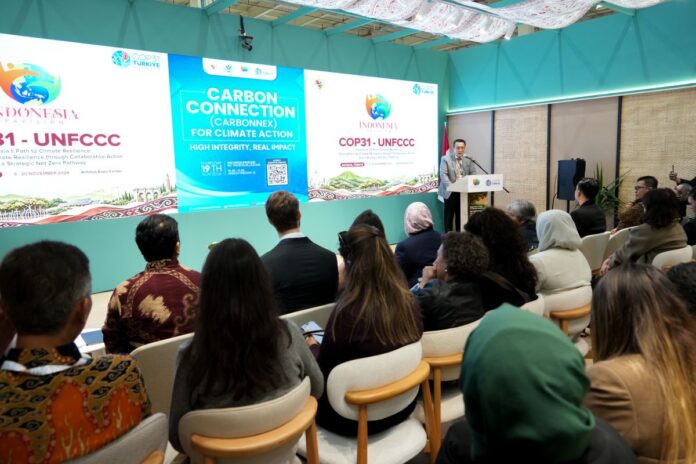
Ecobiz.asia – Indonesia secured seven cooperation outcomes through its Carbon Connection Session (CarbonNex) at the COP31 Indonesia Pavilion in Antalya, Türkiye, including its first agreement under Article 6.2 of the Paris Agreement, targeting up to 12 million tonnes of CO₂ equivalent in emission reductions by 2038.
Organised by Indonesia’s Ministry of Environment and Environmental Control Agency (KLH/BPLH), the 10-day forum, which began on Nov. 10, brought together 17 Indonesian project developers with international partners, financial institutions and investors to explore partnerships and financing for domestic climate projects.
Three agreements were signed at the Indonesia Pavilion during the forum. The first involved state-owned electricity company PT PLN (Persero) and the Global Green Growth Institute (GGGI), acting as fund manager of the Norwegian Article 6 Climate Action Fund. The agreement marks Indonesia’s first cooperation arrangement under Article 6.2 of the Paris Agreement, with a target of reducing emissions by up to 12 million tonnes of CO₂e through the development of floating solar power plants equipped with battery storage.
The two other agreements involved Pertamina and Inhutani for the conservation of the Rangkong Basaken forest, and state-owned gas company PGN and Unilever for the development of biomethane.
In the energy sector, PLN also mobilised US$2.94 billion in energy transition financing, including US$1.1 billion through the Just Energy Transition Partnership (JETP). The company signed power purchase agreements and letters of intent for hydropower, solar and wind projects with a combined capacity of around 330 megawatts.
CarbonNex also provided a platform for project developers to present investment opportunities. Through its Carbon Project Pitching sessions, 17 developers showcased 30 climate action projects covering forestry, energy, agriculture and waste management. Six projects focused on blue carbon, including four proposed by the Ministry of Marine Affairs and Fisheries.
Alongside the project-pitching sessions, KLH/BPLH launched the Indonesia Climate and Carbon Partnership (ICCP) on Nov. 10. The platform is designed to connect Indonesia’s national priorities with international partners offering technical expertise, technology and financing through eight Priority Support Packages.
By the end of CarbonNex, eight partners had presented potential support, ranging from industrial decarbonisation and carbon registry development to assistance with implementing Article 6 of the Paris Agreement.
KLH/BPLH also held 10 bilateral meetings with prospective partners, including Rubicon, WWF, BeZero Carbon and GenZero. The meetings generated interest from four potential partners in developing pilot projects in the waste management sector.
Haryo Pambudi, director of carbon economic value implementation governance at KLH/BPLH, said the ICCP would help expand Indonesia’s international cooperation, particularly in implementing Article 6.2.
“Several international partners are still preparing cooperation arrangements through the ICCP. This is important for strengthening Indonesia’s partnerships, particularly in implementing Article 6.2. In addition to cooperation with Norway, Indonesia already has partnerships with Japan, South Korea and Singapore,” Haryo said in a statement as quoted on Monday (Nov. 11, 2026).
He added that support offered by international partners would be followed up with relevant ministries, government agencies and sectors in 2027.
Deputy Environment Minister and Deputy Head of the Environmental Control Agency Diaz Hendropriyono said Indonesia aimed to strengthen its position in the global carbon market by prioritising credit quality, market confidence and legal certainty.
“We want to become a market with integrity. With integrity, Indonesia can become a dominant player in global carbon trading because we have forests, mangroves and projects, and now we have credible regulations,” Diaz said.
He said international market confidence depended on the availability of carbon credits that were valid, verified and authorised, and accompanied by corresponding adjustments to prevent double counting under the Paris Agreement.
Over the past 18 months, the government has strengthened the regulatory framework through Presidential Regulation No. 110/2025 and its implementing regulations. Indonesia’s Carbon Unit Registry System (SRUK), launched on July 9, 2026, also requires carbon transactions to be recorded within two working days.
The SRUK is being linked with international registries, beginning with Verra, to improve transaction traceability and prevent the double counting of carbon credits.
On project readiness, 47 projects under the national certification scheme have an estimated emissions reduction potential of around 4.6 million tonnes of CO₂e annually, with five reportedly ready to issue carbon credits. A further 86 projects in the energy sector have a combined emissions reduction potential of up to 22 million tonnes of CO₂e.
The government still needs to complete public consultations on regulations governing authorisation and corresponding adjustments, as well as prepare a national roadmap. Improving local governments’ understanding of carbon markets and climate initiatives is also part of the follow-up work to connect local projects with the economic benefits of carbon trading.
All partnerships and support identified through the ICCP will be consolidated with relevant ministries, agencies and sectors in 2027. The cooperation is intended to support Indonesia’s emissions reduction targets under its Enhanced Nationally Determined Contribution and Second NDC for 2031–2035. ***