

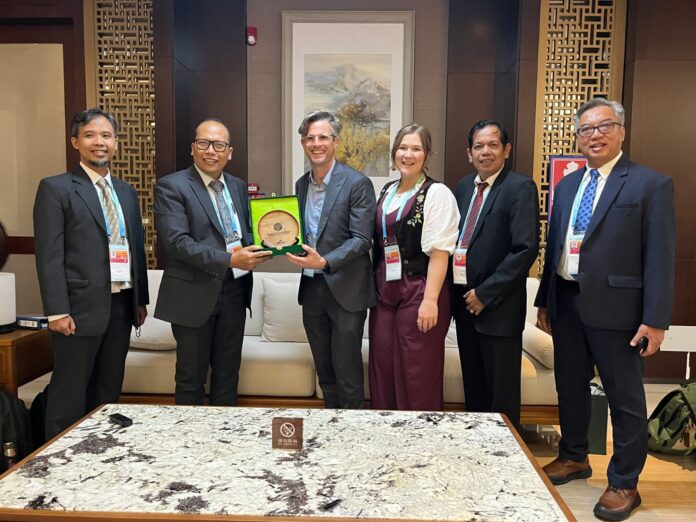
Ecobiz.asia — Indonesia and Australia have agreed to strengthen cooperation on forest governance, legal timber trade, and sustainable forest management as both countries seek to enhance transparency and sustainability in the regional forestry sector.
The commitment was discussed during a bilateral meeting held on the sidelines of the 30th APEC Experts Group on Illegal Logging and Associated Trade (EGILAT) Meeting in Shenzhen, China, on July 29, 2026.
Indonesia’s delegation was led by Krisdianto, Director of Forest Product Revenue and Administration at the Ministry of Forestry, while Australia was represented by Guy Bursle, Assistant Secretary of the Agvet Chemicals and Forestry Branch at the Department of Agriculture, Fisheries and Forestry (DAFF).
Krisdianto said both countries share a common interest in ensuring that forest products are traded legally, sustainably, and in ways that benefit both economies.
“Indonesia and Australia have a shared interest in ensuring that forest products are traded legally, sustainably, and for the mutual benefit of both countries. Stronger cooperation will also reinforce forest governance and enhance confidence in legally traded forest products,” he said.
The discussion followed the direction of Indonesia’s Minister of Forestry Raja Juli Antoni, who has called for international forestry partnerships to strengthen transparent, accountable, and sustainable forest governance while expanding market access for legally sourced forest products.
During the meeting, both sides reviewed progress in implementing the Cooperation Arrangement on Forestry, signed in 2025, which serves as the framework for bilateral collaboration, including through the Australia–Indonesia Working Group on Forestry.
Indonesia welcomed the inaugural Working Group meeting held in January 2026, where the two countries discussed forestry policies, timber legality, evolving international timber trade regulations, the development of Country Specific Guidelines (CSG), and opportunities for cooperation in international forestry forums.
One of the key priorities discussed was the completion of the Indonesia–Australia Country Specific Guidelines, which are expected to streamline bilateral timber trade while maintaining robust standards for legality and traceability.
The two countries also explored opportunities to expand cooperation in sustainable forest management, forest protection and law enforcement, human resource development, and collaboration within international organizations, including the International Tropical Timber Organization (ITTO), the United Nations Forum on Forests (UNFF), and the Committee on Forestry (COFO).
Indonesia also introduced its initiative to establish the World Mangrove Center (WMC) as a global platform for mangrove research, knowledge exchange, capacity building, and international collaboration on sustainable mangrove conservation and management.
The Indonesian delegation invited Australia to participate through joint research, scientific innovation, knowledge sharing, and capacity-building programs focused on coastal ecosystem management.
“Our partnership with Australia has significant room for further development. We hope this cooperation will not only benefit both countries but also contribute to stronger sustainable forest management and legal timber trade across the Asia-Pacific region,” Krisdianto said.
Both governments agreed to continue strengthening technical cooperation, policy dialogue, and knowledge exchange to support sustainable forest governance while facilitating trade in legally verified forest products across the region. ***