
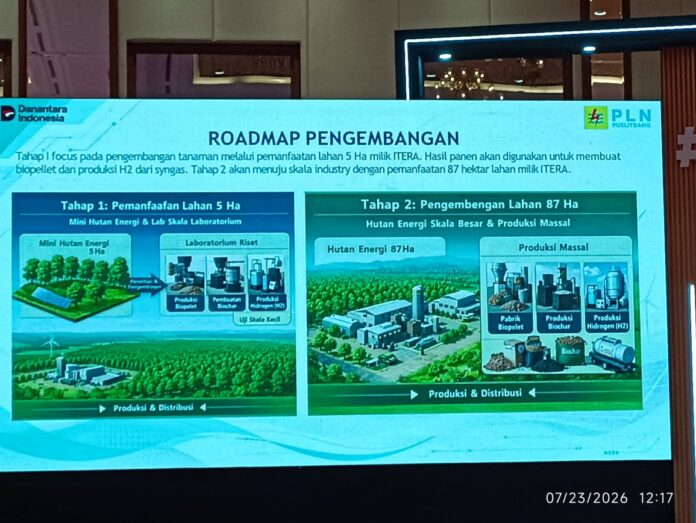
Ecobiz.asia — State electricity firm PT PLN (Persero) has launched a pilot project to develop an integrated biomass and green hydrogen ecosystem by cultivating calliandra and sorghum energy crops on a 5-hectare demonstration plot in collaboration with the Institut Teknologi Sumatera (ITERA), with plans to expand the project to 47 hectares if the initial phase proves successful.
Speaking at the recent Global Hydrogen Ecosystem Summit 2026, Muhamad Iqbal Felani, Senior Manager of Research and Technology for Power Generation Systems and Energy at PLN Research and Development Center, said the pilot project is designed to demonstrate how dedicated energy crops can support biomass co-firing while also becoming feedstock for green hydrogen production through gasification technology.
“The first phase covers around 5 hectares of ITERA-owned land. We will combine calliandra and sorghum because calliandra can improve soil fertility for sorghum,” Iqbal said.
Under the integrated concept, biomass harvested from both crops will be processed into pellets or wood chips for coal co-firing at coal-fired power plants. The same feedstock can also be converted through gasification to produce syngas, which is then processed into hydrogen for electricity generation using fuel cells.
If the pilot delivers positive results, PLN plans to scale up the plantation area to approximately 47 hectares using the same integrated model.
“In the second phase we plan to develop a larger industrial-scale project covering around 47 hectares. Besides producing bio-pellets and biochar, we also aim to produce syngas and hydrogen,” he said.
Iqbal explained that the project involves multidisciplinary research beyond plantation development, including agronomy, chemical engineering, mechanical engineering, electrical engineering and agricultural technology to optimize crop productivity and conversion technologies.
According to PLN’s preliminary simulation, one hectare of calliandra plantation could potentially produce around 27.5-40 tons of biomass annually. At a moderate productivity level of 27.5 tons per hectare per year, the biomass could generate approximately four tons of green hydrogen per hectare annually after gasification and hydrogen production processes.
He acknowledged that biomass remains a subject of debate regarding its environmental credentials, but argued that sustainably managed energy crops are widely regarded as carbon neutral because the carbon dioxide released during combustion is offset by carbon absorbed during plant growth.
“Biomass is considered net zero because the plants absorb CO2 during their lifetime. When they are burned, CO2 is released, but it is essentially balanced by what they have already absorbed,” he said.
Iqbal added that the Lampung pilot remains at a research scale, with gasification currently conducted using laboratory-scale equipment, posing no disruption to surrounding communities.
The location was selected partly because Lampung is home to two coal-fired power plants that have begun implementing biomass co-firing programs.
PLN expects fast-growing sorghum and calliandra plantations to gradually increase local biomass supply, enabling coal substitution at the province’s power plants while reducing carbon emissions from electricity generation.***