
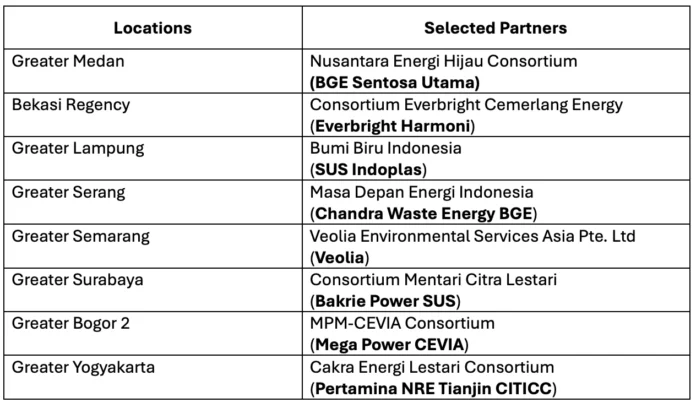
Ecobiz.asia – PT Danantara Investment Management (DIM) has officially issued Conditional Letters of Award (CLoA) to eight selected consortiums for the second phase of Indonesia’s Waste-to-Energy (WtE) development program, marking the next step toward the implementation of projects across eight locations covering 20 regencies and municipalities.
The CLoAs, signal the start of the pre-development phase, during which each consortium must fulfill a series of technical, commercial, and financial requirements before receiving a Final Letter of Award (FLoA).
For the Greater Medan project, the CLoA was awarded to a reserve consortium that was elevated to selected partner status under the reserve partner mechanism established at the outset of the procurement process.
DIM said the decision demonstrates its commitment to maintaining transparent and consistent governance throughout the selection process.
The evaluation was conducted jointly with independent technical, legal, and commercial advisers, assessing each applicant’s waste-to-energy credentials, financial capability, project readiness, commercial viability, strategic value, and risk management capacity.
“The partner selection process conducted by DIM and Denera has been implemented rigorously in accordance with the established mechanism. We expect all selected partners to meet the agreed milestones and uphold strong governance standards throughout project implementation,” Danantara Indonesia Chief Investment Officer Pandu Sjahrir said in a statement as quoted on Wednesday (July 22, 2026).
The second-round procurement was completed in less than seven weeks. From 85 pre-qualified bidders representing seven countries—Indonesia, China, Japan, France, India, South Korea, and Singapore—DIM received 68 proposals for the eight project locations.
Four of the eight winning consortiums are led by Indonesian companies, making Indonesia the largest consortium leader in the second-phase selection. The evaluation process was overseen by both local and international independent advisers.
Following the issuance of the CLoAs, the selected partners are required to prepare bankable feasibility studies, targeted for completion by mid-November 2026. The projects will then proceed to permitting, land handover, and pre-construction activities, with groundbreaking targeted between December 2026 and January 2027.
DIM said that if any selected consortium fails to meet the conditions stipulated in the CLoA, the appointment will be transferred to the designated reserve partner. Should the reserve partner also fail to satisfy the requirements, the project will be reopened for procurement.
The second phase forms part of Indonesia’s broader national Waste-to-Energy development program. Construction of the first-phase Bali project began on July 8, while groundbreaking for projects in Bekasi and Greater Bogor is expected to follow soon.
Once implementation begins, all projects will be developed and operated by PT Daya Energi Bersih Nusantara (Denera), DIM’s dedicated waste management and Waste-to-Energy platform, in partnership with the selected consortiums.
The program is expected to help address Indonesia’s growing municipal waste challenge while generating broader economic and environmental benefits through increased investment, green job creation, greenhouse gas emission reductions, and the expansion of the country’s waste management industry ecosystem. ***