
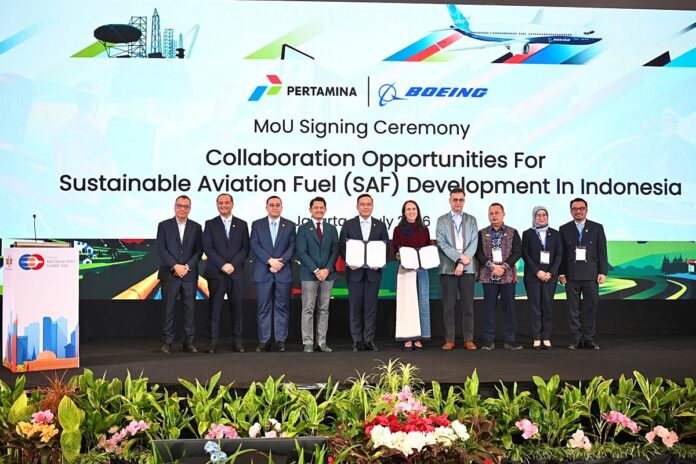
Ecobiz.asia – Indonesia’s state-owned energy company Pertamina and U.S. aerospace manufacturer Boeing have signed a memorandum of understanding (MoU) to explore the development of a sustainable aviation fuel (SAF) ecosystem in Indonesia, as both companies seek to accelerate aviation decarbonization and support the country’s net-zero emissions ambitions.
Under the agreement, the two companies will assess opportunities across the SAF value chain, including feedstock availability, technology development, and policy support needed to accelerate the deployment of sustainable aviation fuel in Indonesia.
Pertamina President Director Simon Aloysius Mantiri said the partnership represents part of the company’s long-term strategy to develop a low-carbon fuels industry.
“This collaboration goes beyond fuel development. It is a long-term investment in building Indonesia’s SAF ecosystem. By combining Pertamina’s domestic resources and refining capabilities with Boeing’s expertise in aviation, we believe Indonesia can accelerate the growth of its sustainable aviation fuel industry,” Simon said in a statement on Tuesday.
According to the ASEAN 2050 SAF Outlook, Indonesia has the potential to become one of Southeast Asia’s largest sustainable aviation fuel producers, with a projected production surplus of around 2.2 million barrels per day by 2050.
Boeing Indonesia Managing Director Indra Duivenvoorde said Indonesia is well positioned to become a regional hub for sustainable aviation development.
He said Boeing will work with Pertamina to identify suitable feedstocks, support technology development, and strengthen education and training programs to help establish a robust SAF ecosystem in the country.
Boeing forecasts that passenger air traffic in Southeast Asia will grow by an average of 7% annually, driving demand for approximately 4,885 new aircraft by 2044. As aviation activity expands, SAF is expected to play a key role in reducing the sector’s carbon emissions. When used in its pure form, sustainable aviation fuel can reduce lifecycle greenhouse gas emissions by up to 80% compared with conventional jet fuel.
Pertamina has already launched several SAF initiatives, including the production and certification of Pertamina Sustainable Aviation Fuel, commercial implementation with Pelita Air, and the development of the Cilacap Biorefinery project through its subsidiary PT Pertamina Patra Niaga. The refinery is expected to produce SAF and Hydrotreated Vegetable Oil (HVO) using used cooking oil and other sustainable waste feedstocks. ***