
Ecobiz.asia — Indonesia’s Ministry of Energy and Mineral Resources (ESDM) is preparing new regulations for carbon trading in the energy sector as part of efforts to strengthen the country’s carbon market governance and unlock potential green financing estimated at up to US$7.7 billion annually.
The regulation, currently being drafted under a proposed Ministerial Regulation on Carbon Trading Through Greenhouse Gas (GHG) Emission Offsets in the Energy Sector, is expected to provide a legal framework for carbon offset transactions and support Indonesia’s transition toward a low-carbon economy.
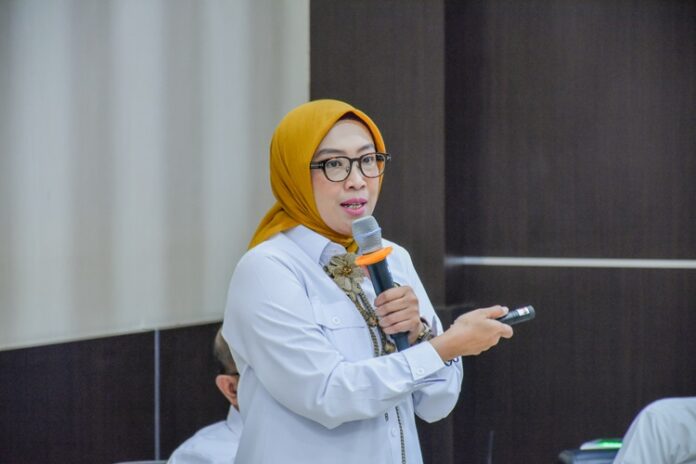
Director General of New, Renewable Energy and Energy Conservation (EBTKE), Eniya Listiani Dewi, said the energy sector plays a critical role in helping Indonesia achieve its Net Zero Emission (NZE) target by 2060 or sooner.
“This is a very significant challenge, and we hope these efforts will accelerate progress toward Net Zero Emission by 2060, or even earlier. The energy sector will be the backbone,” Eniya said, as quoted on Monday (May 25, 2026).
Indonesia has committed to reducing greenhouse gas emissions by 31.89% through domestic efforts and up to 43.20% with international support by 2030. Under its Second Nationally Determined Contribution (NDC), the country is targeting net emissions in the energy sector of between 1.110 billion and 1.336 billion tons of CO2 equivalent by 2035.
To support the target, the ministry recently held a public consultation on the draft regulation involving government institutions, energy companies, validation and verification agencies, academics, and international organizations.
According to Eniya, carbon pricing and carbon offset mechanisms are viewed as strategic instruments to create economic incentives for emission reductions, improve the financial viability of low-carbon projects, and attract new financing into the energy sector.
She said the mechanism could potentially increase Indonesia’s annual green investment inflows by around US$7.7 billion.
Through the new regulation, the government aims to ensure legal certainty for GHG emission offset implementation in the energy sector while maintaining high environmental integrity standards for carbon units generated under the scheme.
The ministry also expects the regulation to strengthen investor confidence and accelerate the development of green projects and low-carbon technologies.
To support transparent and accountable carbon trading implementation, the ministry has prepared several digital platforms, including AKSELERASI for reporting energy-sector emission mitigation actions, SINERGI for energy conservation monitoring, and APPLE Gatrik for emissions reporting in the electricity subsector.
These systems will later be integrated with Indonesia’s Carbon Unit Registry System (SRUK) as part of the country’s broader carbon pricing ecosystem.
Eniya said the public consultation marked an important step toward improving cross-sector policy coordination in implementing Indonesia’s carbon market framework.
“In this public consultation forum, we emphasize four key aspects: the design of the offset mechanism, inter-ministerial coordination, and strengthening support for the implementation of this ministerial regulation so that it remains harmonized with broader carbon economic value policies,” she said.
The government expects stronger regulation and stakeholder collaboration to accelerate the implementation of a credible, transparent, and high-integrity carbon market in the energy sector while reinforcing Indonesia’s green investment ecosystem. ***