
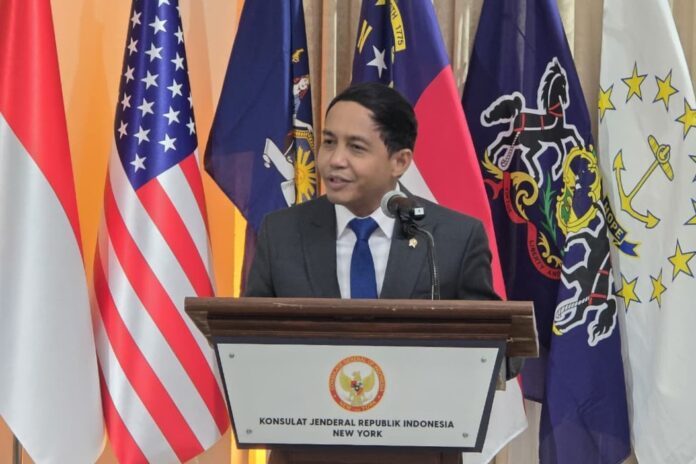
Ecobiz.asia — Indonesia’s Ministry of Forestry reaffirmed its commitment to building a credible, transparent, and internationally aligned forestry carbon market during a business forum held in New York on Monday (May 11, 2026).
The forum, organized in collaboration with the International Emissions Trading Association and the Indonesia America Chamber of Commerce, brought together global carbon market players, investors, and forestry industry representatives at the Indonesian Consulate General in New York.
Indonesia’s Forestry Minister Raja Juli Antoni said the country is entering a new phase of forest management that extends beyond timber production to include carbon value, biodiversity, environmental services, and sustainable green economy development.
“Indonesia has around 120 million hectares of tropical forests, creating major opportunities for global partnerships in climate investment and sustainable forestry business development,” Raja Juli said during the forum.
The minister highlighted the issuance of Minister of Forestry Regulation No. 6/2026 as a key milestone in Indonesia’s forestry sector transformation. The regulation provides legal certainty for businesses to generate, verify, and trade carbon credits from forestry concession areas, including natural production forests, industrial plantation forests, and social forestry areas.
According to Raja Juli, the regulation also strengthens the integration of Indonesia’s domestic carbon market with international standards, including principles established by the Integrity Council for the Voluntary Carbon Market and mechanisms under Article 6 of the Paris Agreement.
The government expects the new framework to improve the competitiveness of Indonesian forestry carbon credits in global carbon markets.
In addition to carbon trading, the Ministry of Forestry is also promoting a multi-business forestry scheme that allows forest concession holders to develop multiple revenue streams simultaneously, ranging from non-timber forest products and environmental services to ecotourism, biochar, and sustainable biomass energy.
Raja Juli said the approach is expected to enhance investment attractiveness by diversifying income sources while strengthening environmental, social, and governance (ESG) aspects within Indonesia’s forestry business model.
Indonesia also reaffirmed its commitment to strengthening forestry governance through the submission of its Forest Reference Emission Level (FREL) to the United Nations Framework Convention on Climate Change, the operationalization of the National Registry System (SRN), and the implementation of Indonesia’s FOLU Net Sink 2030 target, which aims to make the forestry and land-use sector a net carbon sink by the end of the decade.
The forum also served as a platform for Indonesian forestry businesses to showcase the country’s carbon credit potential and strengthen international market confidence in Indonesia’s carbon economic value framework.
Participants included representatives from leading global organizations and companies in carbon markets, environmental commodities, and forestry products, including ACT Commodities, Bloomberg, Verra, Xpansiv, S&P Global, and We Mean Business Coalition.
Chairman of the Indonesian Forest Concessionaires Association (APHI), Soewarso, described the new forestry regulation as a historic milestone in accelerating carbon market development in Indonesia’s forestry sector.
“APHI and all of its members are fully committed to developing high-integrity and credible carbon initiatives. We want to ensure that carbon credits generated from Indonesia’s forests are globally recognized and deliver tangible ecological and economic benefits for communities,” Soewarso said.
Meanwhile, Head of Public Relations and Foreign Cooperation Bureau at the Ministry of Forestry Ristianto Pribadi said the business forum marked an important momentum to expand Indonesia’s green investment network and strengthen the country’s position as a global hub for forestry-based carbon economy development.
“Indonesia is not offering aid, but strategic partnerships backed by government commitment, regulatory certainty, and the enormous potential of our tropical forest resources,” Ristianto said. ***