
Ecobiz.asia — Indonesia and Japan have signed a cooperation agreement covering critical minerals and nuclear energy development to strengthen energy security and support future low-carbon energy technologies in the Asia-Pacific region.
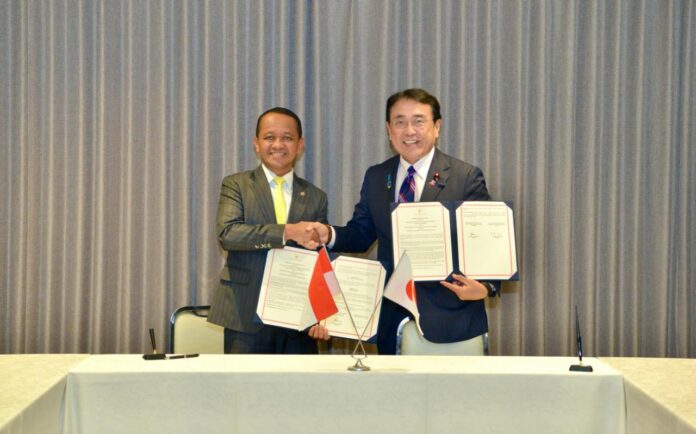
The agreement was signed during a bilateral meeting between Indonesia’s Energy and Mineral Resources Minister Bahlil Lahadalia and Japan’s Minister of Economy, Trade and Industry Ryosei Akazawa on the sidelines of the Indo-Pacific Energy Security Ministerial and Business Forum in Tokyo, Japan, on Sunday (March 15, 2026).
The two countries signed a Memorandum of Cooperation (MoC) aimed at strengthening critical mineral supply chains and promoting collaboration in low-carbon nuclear energy technologies.
“I strongly welcome the memorandum we signed today, particularly in the field of critical minerals. We are very open and welcome the Japanese government and Japanese businesses to jointly develop Indonesia’s critical mineral resources,” Bahlil said.
The cooperation in critical minerals is expected to help build more secure and reliable global supply chains while supporting the development of clean energy technologies that rely on strategic mineral resources.
Bahlil said Indonesia holds a strategic position in global mineral supply chains, noting that the country accounts for around 43% of the world’s nickel reserves, in addition to significant resources of bauxite, tin, copper and rare earth elements.
“If we can implement this cooperation effectively, I believe it will be highly beneficial,” he said.
Akazawa said strengthening energy cooperation between countries has become increasingly important amid global geopolitical tensions and uncertainty in energy supply.
“In the current global crisis situation, it is important for us to strengthen cooperation to maintain energy security. Japan itself has prepared strategic energy reserves as a precautionary measure,” he said.
He also expressed appreciation for Indonesia’s support in supplying liquefied natural gas (LNG) to Japan and reaffirmed his country’s commitment to supporting various joint energy projects in Indonesia.
In addition to critical minerals, the agreement also includes cooperation in nuclear energy technology development with a strong emphasis on safety standards, leveraging Japan’s experience in low-carbon energy development.
Looking ahead, Indonesia and Japan plan to continue discussions on broader energy cooperation, including strengthening supply chains for LNG and coal and accelerating energy transition projects under the Asia Zero Emission Community (AZEC) framework.
Projects linked to the cooperation include efforts to strengthen operations at the Sarulla Geothermal Power Plant and the completion of the Legok Nangka Waste-to-Energy Plant project in West Java. ***