

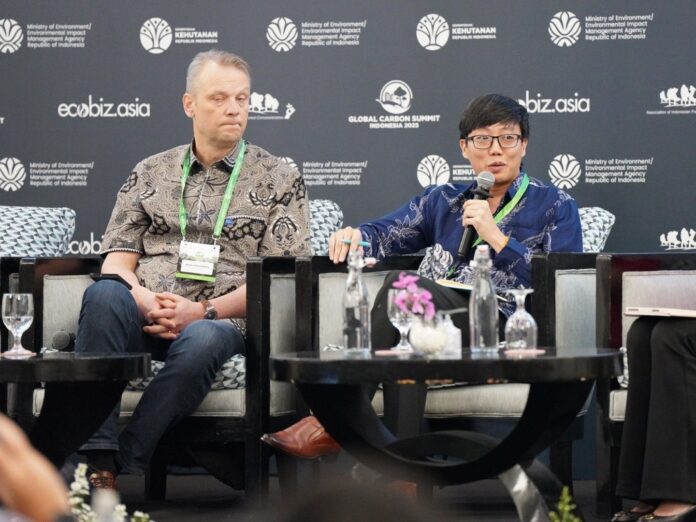
Ecobiz.asia — Global carbon standards body Verra is pushing a comprehensive digital overhaul of its standards and methodologies, saying the move is critical to improving transparency and accelerating the issuance of carbon credits as global demand surges.
Speaking at the Global Carbon Summit Indonesia 2025 hosted by Ecobiz Asia in Jakarta on Nov. 26–27, Win Sim Tan, Verra’s regional representative for Asia and the Pacific, said carbon markets can no longer rely on slow, fragmented manual processes, particularly in developing economies such as Indonesia and across Southeast Asia.
“The key word is digitalisation,” Tan said. “If demand continues to rise, supply must increase, and that can only happen if standards themselves evolve.”
Verra has begun rolling out its digital transition through the development of a Project Hub, a single-entry digital platform for carbon project submissions. Under the new system, Verra will phase out document-based submissions using Word and Excel files.
“All submissions will be made through standardised digital forms,” Tan said. “This improves consistency and significantly increases efficiency.”
The organisation has also started introducing digital methodologies, allowing emissions calculations to be conducted directly within Verra’s system rather than through external spreadsheets. The shift is aimed at reducing input errors and interpretation gaps that have historically slowed project validation.
“Project developers no longer need to calculate emissions manually outside the platform,” Tan said. “The system supports calculations in line with the approved methodology.”
Digitalisation is also being applied to project reviews. Through a digital review process, all stages of validation can now be tracked in real time, from project developers to validators and Verra itself.
“We can clearly see who is responsible at each stage,” Tan said. “There is no longer confusion over where a project stands in the process.”
Verra said the reforms respond to feedback from market participants over the past two years, many of whom raised concerns about lengthy review timelines. The organisation expects the digital changes to shorten issuance cycles while strengthening accountability.
Without process reform, Tan warned, carbon markets risk falling behind business needs and global climate targets.
“If the market is to scale, standards must change,” he said. “And that change has to start with digitalisation.” ***