
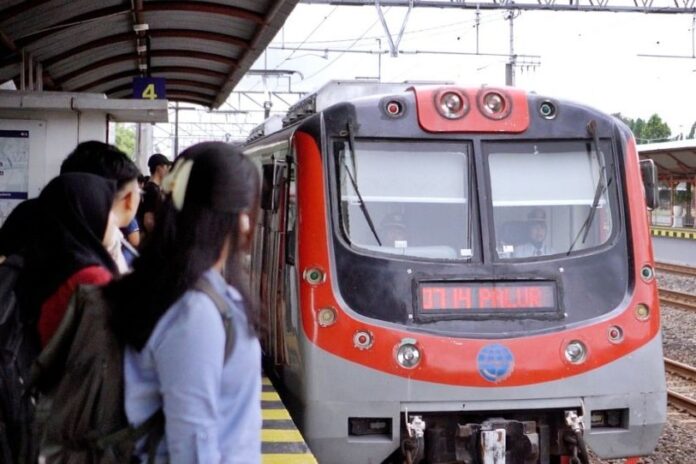
Ecobiz.asia — Indonesia’s state railway operator PT Kereta Api Indonesia (KAI) has unveiled a long-term decarbonisation roadmap with support from the UK government through the UK Partnering for Accelerated Climate Transition (UK PACT) programme, targeting net-zero emissions by 2060.
The initiative is part of broader UK-Indonesia climate cooperation aimed at accelerating low-carbon transport development and expanding access to green financing for Indonesia’s rail sector.
The roadmap was developed with support from consultancy firms Palladium and Kynergy Consulting under the UK PACT framework.
KAI Vice President of Sustainability Tria Mutiari Meilan said rail transport has significant potential to shift commuters away from private vehicles toward lower-carbon mass transportation, making it one of the most efficient tools for reducing transport emissions at scale.
“This roadmap will serve as a guideline to gradually reduce emissions while maintaining service quality and business sustainability,” Tria said during a media briefing on Thursday (June 11, 2026).
Under the roadmap, KAI aims to cut emissions by 25.76% by 2030, equivalent to 166,873 tons of CO2e from a baseline of 647,785 tons CO2e. The company targets a 35.55% reduction by 2035, rising to 78.17% by 2050, before reaching net-zero emissions in 2060.
A central pillar of the strategy is the electrification of rail infrastructure across Indonesia’s network.
KAI plans to electrify approximately 1,038.7 kilometres of rail lines, including commuter rail systems, the Jabodebek LRT network, and the Jakarta-Bandung high-speed railway, known as Whoosh.
Tria said electrification forms part of the company’s “eliminate” strategy, aimed at reducing carbon emissions through transport system design and cleaner energy use.
“Electrification allows us to reduce carbon emissions directly through system design while creating a more eco-friendly transport ecosystem,” she said.
She added that expanding electrified rail services could also encourage greater modal shift from private vehicles to public transport.
“We will continue working to increase the share of electrified railways across the national railway network,” she said.
Kynergy Consulting Project Director Rekyan Eckersley said railways currently account for only around 1% of greenhouse gas emissions from Indonesia’s transport sector, far below road transport, which contributes roughly 89%.
“Strengthening railway capacity and attractiveness is therefore a crucial part of Indonesia’s transport decarbonisation strategy, and we are proud to support KAI in formulating it,” he said.
Beyond electrification, KAI’s roadmap includes operational efficiency measures, green building certification for stations and depots, expanded solar panel installations, and the transition from conventional diesel fuel toward higher biodiesel blends.
Indonesia currently mandates B40 biodiesel and plans to introduce B50 blends in 2026.
KAI has also installed solar panels with a total capacity of 3,435.5 kilowatt-peak across 66 locations and planted more than 107,000 trees between 2021 and 2025.
According to company data, emissions intensity from several rail services remains relatively low compared with other transport modes. Jabodebek LRT records emissions of 15 grams CO2-equivalent per passenger-kilometre, while intercity trains emit 16.43 grams CO2-equivalent per passenger-kilometre.
The UK-backed programme also includes studies on lifecycle cost analysis for B50 biodiesel adoption, acceleration of diesel-to-electric rail transitions, signalling system modernisation, and the development of operator-based financing schemes linked to global green finance instruments.
The partnership is expected to help KAI access international climate financing mechanisms, including sustainability bonds and other green investment facilities, to support long-term low-carbon rail infrastructure development in Indonesia. ***