

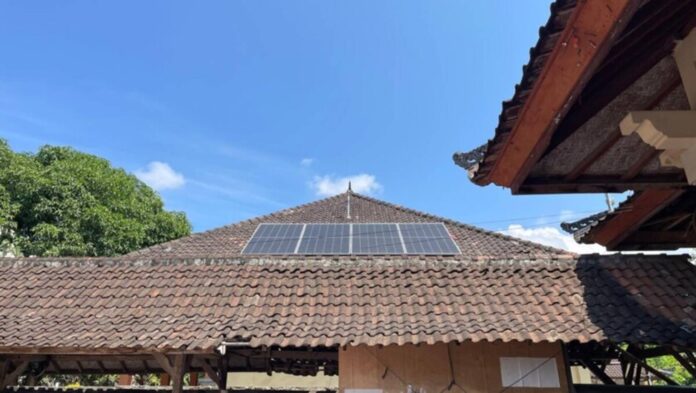

Ecobiz.asia – The Institute for Essential Services Reform (IESR), working with the Bali provincial government and philanthropic partner ViriyaENB, has switched on four micro solar-roof systems totaling 15.37 kWp across three villages: Banjarasem (Buleleng), Baturinggit (Karangasem), and Batununggul-Nusa Penida (Klungkung). The systems are each paired with a small battery and inaugurated on August 27, 2025 and are part of Bali’s push to net-zero by 2045 and Nusa Penida’s ambition to be 100% renewable by 2030.
Hardware details are reported as follows:
- Banjarasem Village Hall (Seririt, Buleleng): 3.48 kWp PV + 4.8 kWh battery (power community hall/public services).
- Baturinggit Village (Kubu, Karangasem): 3.48 kWp PV + 4.8 kWh battery (power a community water pump and revenue-saving for PAMSIMAS/Penyediaan Air Minum dan Sanitasi Berbasis Masyarakat).
- Nusa Penida Sub-district Office (Kantor Camat): 5.95 kWp PV + 4.8 kWh battery (power public administration office).
- SDN 1 Batununggul (Elementary School, Nusa Penida): 2.46 kWp PV + 5.12 kWh battery (power education needs load and daylight self-consumption).
IESR notes these systems have been operating since July 2025, with the sub-district office targeted for full operation in September 2025.
Why these micro systems matter commercially
Individually, these are micro projects. Collectively, they demonstrate a replicable building block for diesel-dependent islands and public-facility loads under Indonesia’s new rooftop rules. Nusa Penida and sister islands historically rely on diesel plants under 20 kV radial networks; legacy studies cite ~7 MW of installed diesel capacity in the cluster. Even before today’s oil volatility, diesel generation in outer off-grid systems was costly for PLN and the state. IESR estimates diesel-only electricity production costs up to ~Rp4,500/kWh for Nusa Penida’s system.
Under MEMR Reg. 2/2024, net-metering is abolished and rooftop solar is governed by quota and approval windows. It aims to open up the economic usage for public buildings and SMEs outside big grids.
Bali launched a rooftop-solar acceleration program in May 2025 targeting government buildings, hotels, villas, schools, and markets with flexible fit to Bali’s geography and tourism-driven economy. Micro pilots that keep civic services and water pumps running without diesel generators are the best possible advertisement.
The numbers that matter (and how to think about them)
Bali’s solar resource yield potential is solid. The World Bank’s Global Solar Atlas shows ~1,600–1,700 kWh/kWp/year in the Denpasar region, which is good enough for back-of-envelope business cases. Using a conservative specific yield, these newly installed four micro systems would produce roughly:
- Banjarasem (3.48 kWp): ~5,860 kWh/year
- Baturinggit (3.48 kWp): ~5,860 kWh/year
- Kantor Camat Nusa Penida (5.95 kWp): ~10,020 kWh/year
- SDN Batununggul (2.46 kWp): ~4,143 kWh/year
Totalling to ~25,900 kWh/year. If every kWh from these systems displaces diesel generation at the system-level production cost of Rp4,500/kWh, the gross avoided cost is on the order of ~Rp116 million/year across the four sites.
Moreover, batteries here are small (~5 kWh each) but surgical: they bridge short outages, buffer water pumps and office/school loads, and increase on-site self-consumption, which now drives the economics (more working hours and service reliability) with the absence of net metering.
Signals for EPCs, Suppliers, and Lenders
Bali’s four micro PLTS sites prove that small, battery-backed rooftops on public loads work technically under Indonesia’s post-net-metering regime and matter economically on island feeders where diesel still sets the marginal cost. The commercial move now is to scale these use-cases. Package similar facilities into a single procurement: think 20-50 roofs per tranche, each in the 3-6 kWp PV + ~5 kWh LFP battery class. Design specifically for self-consumption and quota compliance under MEMR 2/2024; forget the old net-metering mindset. The value driver is shifting midday surplus into late-afternoon service hours and trimming diesel runtime without destabilizing feeders.
On islands bound by take-or-pay diesel PPAs, engage PLN early on hybrid dispatch protocols and progressive relief as renewable share rises; otherwise physical fuel savings won’t show up in accounting soon enough to please a credit committee. Philanthropic or climate-program seed capital (like what supported these pilots) can bridge first-loss risk on the initial bundle; subsequent tranches should lean on standardized EPC contracts and service-level guarantees, not bespoke grants.
Sequencing deployment also matters. Start with public facilities that are visible, predictable, and politically easy: offices, schools, Puskesmas, and water pumps. Then extend into tourism-adjacent businesses where daytime loads are heavy and brand value rewards resilience (hotels, markets, cold storage F&B). Time submissions to the January/July regulation windows, and publish an asset list with tiered readiness so lenders can underwrite pipeline, not projects one-by-one.
The goal isn’t to turn each roof into a microgrid, but rather to deploy a copy-paste kit that consistently converts low-value midday kWh into high-value self-use, cuts outage pain for civic services, and chips away at diesel usage cost. Get those three right, and the next award won’t be for a single school or office, it’ll be for every school on the Indonesia’s islands, financed on the back of measured results. ***