
Ecobiz.asia – PT Riau Andalan Pulp and Paper (RAPP), part of APRIL Group, has reaffirmed its commitment to complying with applicable laws and regulations and implementing sustainable forest management practices throughout its operations in Riau, Indonesia.
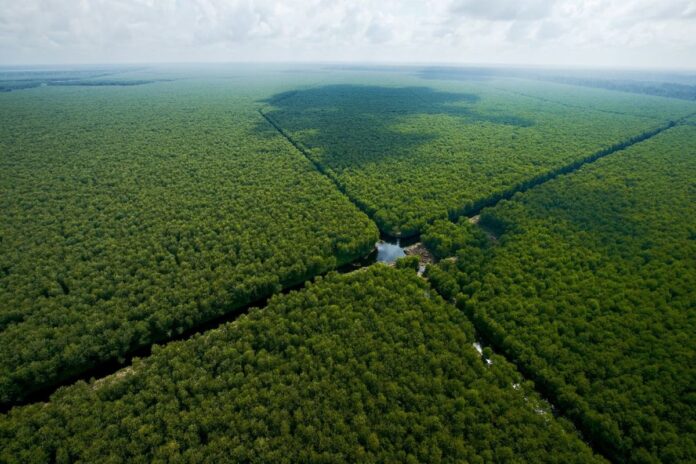
The company said it had consistently applied best practices in managing its 338,536-hectare industrial plantation forest concession, including fire prevention and management, responsible peatland management, and biodiversity conservation.
“PT RAPP firmly believes that, in managing its 338,536-hectare industrial plantation forest concession, it has always complied with applicable laws and regulations,” the company’s management said in a statement issued on Tuesday (Nov. 24, 2026).
The statement follows the Forestry Ministry’s revocation of RAPP’s Forest Utilisation Business Licence (PBPH), covering approximately 338,536 hectares in Riau, through Ministerial Decree No. 971 of 2026, dated Nov. 19, 2026.
RAPP said it had formally received the decree and was conducting a comprehensive review of the grounds for the licence revocation.
The company said it had implemented a No Burn Policy since 1993, supported by an integrated fire management approach covering prevention, early detection and rapid response. It added that its fire management capabilities complied with applicable regulations and national and international standards.
Through its Fire Free Village Programme, RAPP works with more than 40 villages in Riau to prevent forest and land fires by providing mechanical alternatives for agricultural land preparation. The programme has covered approximately one million hectares and, according to the company, reduced fire incidents by more than 90%.
RAPP said it did not tolerate burning practices and maintained that fire incidents were not caused by its operations. It added that most fires were extinguished within 24 hours.
On peatland management, the company said it applied a science-based approach involving water management, silvicultural practices and greenhouse gas (GHG) emissions monitoring. It also supports research into tropical peatland science and shares data and findings with national and international scientific communities and other stakeholders.
In partnership with a global conservation organisation, RAPP said it manages and protects one of the largest peatland restoration areas in Riau, which provides habitat for more than 900 species of flora and fauna.
Regarding land claims and social issues within its concession, RAPP said it worked with communities and local governments to resolve conflicts involving encroachment, mining and illegal plantations, including oil palm plantations. The company said it regularly reported land conflict cases to the Ministry of Forestry.
RAPP also reaffirmed its commitment to forest conservation, biodiversity and wildlife protection, saying it condemned wildlife crime and supported law enforcement efforts in cooperation with relevant authorities.
The company said its operations involved around 41,000 employees and their families, as well as hundreds of local micro, small and medium-sized enterprises (MSMEs). It expressed concern that the licence revocation could affect the regional economy and community welfare in Riau.
As an export-oriented company, RAPP said it was an important contributor to Indonesia’s foreign exchange earnings, adding that disruptions to its operations could affect employment and associated supply chains.
“We respect the government’s decision and will continue to maintain constructive relations with the relevant agencies,” the company’s management said.
Meanwhile, Barita Simanjuntak, spokesperson for the Forest Area Enforcement Task Force (Satgas PKH), said the revocation of RAPP’s licence would not automatically halt the company’s operations or lead to layoffs.
The government, he said, had coordinated a follow-up management arrangement involving state-owned enterprises (SOEs) and regionally owned enterprises (BUMDs) to ensure the continuity of business activities while protecting the interests of workers and surrounding communities. ***