
Ecobiz.asia – ASEAN needs approximately US$405 billion in annual investment through 2060 to implement its coordinated energy transition pathway, while accelerating renewable energy development, improving energy efficiency and strengthening regional electricity connectivity, according to the ASEAN Centre for Energy (ACE).
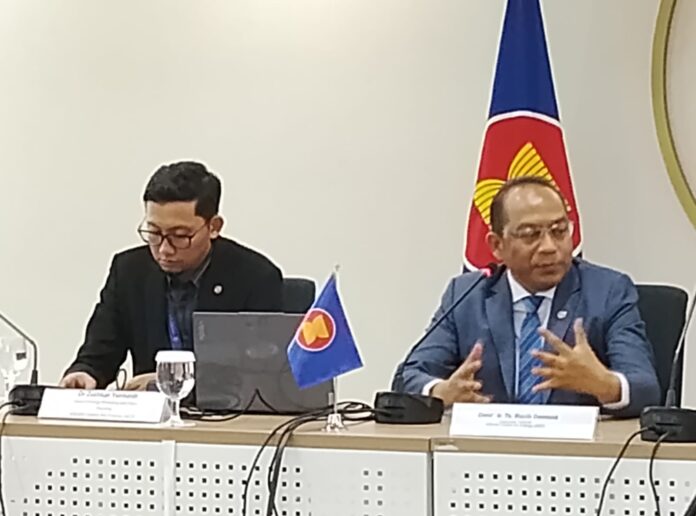
Dato’ Ir. Ts. Razib Dawood, Executive Director of ACE, said the investment requirement would reach approximately US$14.1 trillion through 2060 under the ASEAN Coordinated Transition Scenario (ACTS) outlined in the 9th ASEAN Energy Outlook (AEO9).
Speaking at the opening of the AEO9 Exhibition at the ASEAN Secretariat in Jakarta on Tuesday (Nov. 24, 2026), Razib said the region faced significantly different energy consumption trajectories depending on the pace of policy implementation and energy transition efforts.
Under the Baseline Scenario, ASEAN’s final energy consumption is projected to increase more than fourfold, from approximately 485 million tonnes of oil equivalent (Mtoe) in 2025 to 2,047 Mtoe by 2060.
However, the outlook presents alternative pathways if ASEAN member states accelerate the implementation of their energy policies and targets.
Under the ASEAN Member States Target Scenario (ATS), final energy consumption could be limited to 1,482 Mtoe by 2060. Meanwhile, the more ambitious ACTS, which assumes faster progress in energy efficiency, electrification and fuel switching, could reduce consumption further to 1,073 Mtoe.
This would be nearly half the level projected under the Baseline Scenario while maintaining a similar economic growth trajectory, Razib said.
He emphasized that ASEAN’s energy security would depend not only on domestic energy production and imports but also on improving energy efficiency and strengthening regional energy connectivity.
“Energy security depends not only on how much energy we produce or import, but also on how efficiently we use it and how well our systems are connected,” he said.
Razib also highlighted the scale of renewable energy development required to achieve ASEAN’s target of a 45% share of renewable energy in installed power capacity by 2030.
The region would need to add approximately 26 gigawatts (GW) of renewable energy capacity annually, nearly four times its previous rate of additions, he said.
He said the expansion would need to be accompanied by stronger electricity grids, greater energy storage capacity, development of the ASEAN Power Grid (APG) and increased cross-border electricity trade.
The regional power grid initiative is expected to play an important role in improving electricity connectivity among ASEAN member states and supporting the integration of renewable energy into their power systems.
Razib warned that the region’s increasing dependence on imported oil also exposed ASEAN economies to external shocks, reinforcing the need to diversify energy sources and improve energy efficiency.
“Our 2030 targets are an important milestone, not the finish line. The choices we make today will shape ASEAN’s energy security, competitiveness, and sustainability for decades to come,” he said.
The AEO9 was officially launched on Oct. 8 during the ASEAN Energy Business Forum in Manila, alongside the 44th ASEAN Ministers on Energy Meeting.
The exhibition at the ASEAN Secretariat aims to present the report’s findings through visual displays and infographics, making its analysis more accessible to policymakers, industry players, development partners, academics and the wider public.
Razib said the findings of AEO9 should serve as a reference for policymaking, investment decisions and stronger regional cooperation.
He also acknowledged the contributions of ASEAN member states, national experts, the Regional Energy Policy and Planning Sub-Sector Network, the ASEAN Secretariat, development partners and other institutions involved in preparing the outlook.
“The true value of AEO9 lies in how its findings inform policies, guide investments, and strengthen cooperation across ASEAN,” he said. ***