
Ecobiz.asia – Indonesia’s state-owned electricity company PT PLN (Persero) is preparing to launch Mentari Nusantara 2, a large-scale solar power procurement programme with a planned capacity of 1.9 gigawatt-peak (GWp), following market consultations with potential developers.
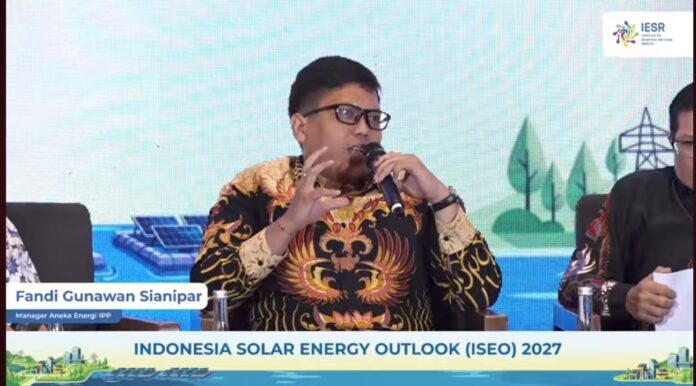
Fandi Gunawan Sianipar, Manager of Various Renewable Energy at PLN’s head office, said the company had held consultations with developers to provide early information about the upcoming procurement and give potential participants time to prepare.
“We are also ready to launch Mentari Nusantara 2, with an even larger capacity of 1.9 GWp. We have conducted market consultations with developers and informed them about the project,” Fandi said during a panel discussion at the launch of the Indonesia Solar Energy Outlook (ISEO) 2027 and a policy brief on simplifying floating solar permitting, organised by the Institute for Essential Services Reform (IESR) on Wednesday (Nov. 18, 2026).
The planned procurement will build on the experience of Mentari Nusantara 1, launched in the first half of 2026 with a capacity of 1,245 megawatts (MW) alternating current (AC), equivalent to approximately 1.7 GWp.
The first phase adopted a bundled procurement model covering 22 project locations. Instead of conducting separate procurement processes for each site, PLN combined them into a single tender and evaluation process.
Fandi said the approach was designed to improve economies of scale, attract more developers and accelerate procurement.
“By bundling the procurement, the market becomes more attractive from an economies-of-scale perspective. For PLN, the procedures can also be completed more quickly because we conduct procurement for 22 locations in one process, with a single evaluation covering all 22 projects,” he said.
Under the scheme, PLN’s subholding companies may also participate in the projects, provided they are interested, with a maximum shareholding of 30%.
Fandi outlined three main approaches PLN uses to procure renewable energy projects: direct development by PLN, assignments to its subholding companies to seek partners, and independent power producer (IPP) schemes. The IPP approach includes both projects developed solely by private investors and arrangements allowing PLN subholding companies to participate.
The procurement model is selected according to individual project conditions and readiness. Fandi said separate procurement processes for multiple projects could take considerable time, prompting PLN to adopt bundled procurement where suitable.
Renewable projects
Beyond Mentari Nusantara 2, PLN is preparing other large-scale renewable energy projects as part of the government’s 100-GWp solar power development programme.
Fandi said PLN had also informed the market about an upcoming solar power project aimed at reducing fuel consumption, allowing developers to prepare for the procurement process.
The company had conducted market consultations the previous week for another large-scale renewable energy development, the 1.2-GW AC Bayu Nusantara wind power project.
However, Fandi said bundled procurement would be implemented gradually, depending on the readiness of individual projects and the electricity system’s capacity to accommodate additional renewable energy generation.
“Bundling is necessary to accelerate project execution. However, implementation will be carried out in stages, depending on project readiness and system readiness,” he said. ***