

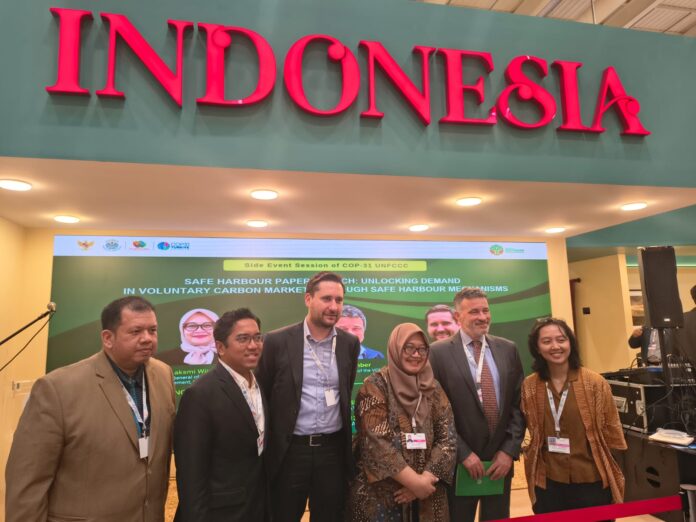
Ecobiz.asia – Indonesia has welcomed proposals for a safe harbour mechanism to provide legal certainty for companies purchasing and using carbon credits, as governments and market stakeholders seek to reduce the risk of litigation and greenwashing allegations that could discourage demand in voluntary carbon markets.
The mechanism was discussed at the launch of a report titled Unlocking Demand in Voluntary Carbon Markets through Safe Harbour Mechanisms: A Recommendation to Governments at the Indonesia Pavilion during the 31st UN Climate Change Conference (COP31) in Antalya, Türkiye, on Saturday (Nov 14, 2026).
Safe harbour is designed to offer legal protection to companies that use carbon credits in accordance with specified requirements and standards. By clarifying which credits qualify and what claims companies can make about their use, the approach aims to give businesses greater confidence in participating in voluntary carbon markets.
Laksmi Wijayanti, Director General of Sustainable Forest Management at Indonesia’s Ministry of Forestry, said the growth of carbon markets depended not only on credit supply but also on buyer confidence, legal certainty and assurance that credits represented genuine emissions reductions.
Companies currently face legal and reputational risks when purchasing carbon credits and making public claims about their use, she said. Such uncertainty could deter investment, including in projects that generate high-quality credits.
Ilham, Director of Forest Utilisation Business Development at the ministry, said Indonesia was strengthening the legal framework and governance of carbon trading, including through the development of safe harbour approaches, more standardised contracts and dispute-resolution mechanisms.
“These efforts are expected to increase transaction certainty while ensuring that carbon market development remains aligned with national policies and Indonesia’s climate commitments,” he said.
The report was prepared by the International Emissions Trading Association (IETA), with support from the Coalition to Grow Carbon Markets (CGCM). Indonesia and the United Kingdom also supported the development of the recommendations, which are intended to help governments strengthen demand for voluntary carbon credits.
IETA Senior Director Andrea Bonzanni said the initiative was prompted by the pressure and criticism faced by companies that voluntarily purchase carbon credits, particularly when their environmental claims are challenged as misleading.
Some companies have faced lawsuits after using carbon credits and making claims such as carbon neutrality, he said. The resulting uncertainty has made businesses more cautious and, in some cases, led them to delay the use of carbon credits.
“Through safe harbour mechanisms, we want to provide a level of certainty that companies meeting the requirements will not automatically face criticism or legal action. This certainty and trust are what the carbon market needs to continue growing,” Bonzanni said.
Voluntary Carbon Markets Integrity Initiative (VCMI) Executive Director Mark Kenber said safe harbour would complement, rather than replace, national regulations. Companies would still be required to comply with the laws and regulations of the countries in which they operate.
The proposed mechanism covers two main areas: the quality of carbon credits and the accuracy of corporate claims. On credit quality, eligible credits would need to meet recognised standards or frameworks, including the Paris Agreement’s Article 6.4 mechanism, the Integrity Council for the Voluntary Carbon Market’s (ICVCM) Core Carbon Principles, the Carbon Offsetting and Reduction Scheme for International Aviation (CORSIA), or standards established by individual governments.
The second area concerns how companies communicate their use of carbon credits to the public. Companies would be expected to make accurate disclosures and avoid implying that all their emissions had been eliminated when they had instead been offset through the purchase of credits. ***