
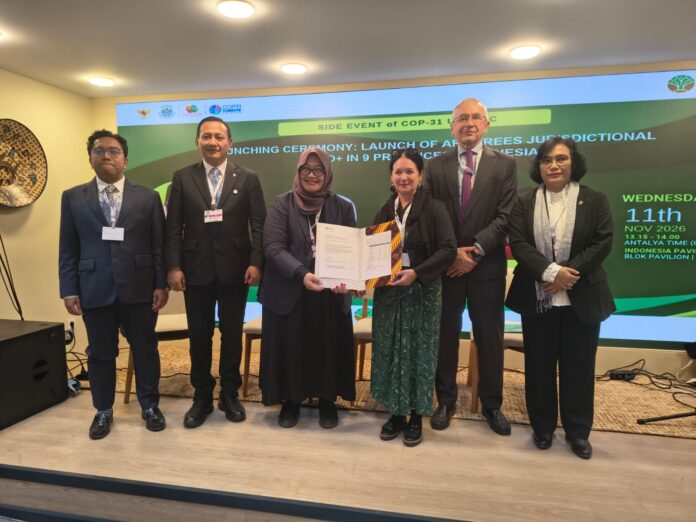
Ecobiz.asia – Indonesia has launched a jurisdictional REDD+ programme under the Architecture for REDD+ Transactions (ART) TREES standard covering nine provinces and approximately 38.6 million hectares of forest, equivalent to around 40% of the country’s total forest cover.
The launch took place at the Indonesia Pavilion during the UN Climate Change Conference (COP31) in Antalya, Türkiye, on Wednesday (Nov. 11), marking a step forward in Indonesia’s efforts to develop jurisdictional forest carbon programmes.
The programme’s TREES Concept has been accepted by ART and published on the ART Registry, marking the first step towards registering Indonesia’s nine provincial programmes under the standard.
Deputy Minister of Forestry Rohmat Marzuki said Indonesia aimed to develop a credible and inclusive forest carbon market that supports national priorities and shared climate goals.
“Carbon finance should reinforce conservation, restoration, sustainable forest management, biodiversity protection, and measurable climate results,” Rohmat said.
He outlined six priorities for Indonesia’s forest carbon development, including unlocking the country’s natural carbon potential, strengthening forest protection and ecosystem restoration, empowering Indigenous Peoples and local communities, and expanding complementary financing sources.
These financing sources include results-based payments, carbon markets, development cooperation, philanthropy, and responsible private investment, aligned with national priorities and local needs.
Rohmat also stressed the importance of maintaining the integrity of forest carbon credits through transparent governance, robust measurement and accounting, independent validation and verification, and safeguards to prevent double counting.
“Indonesia will uphold national ownership, transparent governance, safeguards, and equitable benefit sharing,” he said.
He added that international financing and carbon markets should complement public funding for forest protection, peatland management, fire prevention, restoration, and community livelihoods.
Director General of Sustainable Forest Management at the Ministry of Forestry Laksmi Wijayanti said the nine provinces would follow two different crediting approaches based on their respective forest conditions.
Central Sulawesi, East Kalimantan, Jambi, and Riau will pursue credits for reducing emissions from deforestation and forest degradation. Meanwhile, North Maluku, Papua, West Papua, Southwest Papua, and Papua Highlands will participate under the High Forest, Low Deforestation (HFLD) approach.
“This reflects a simple principle. We should reward provinces that are bringing deforestation down, and we should also reward provinces that have kept their forest standing all along,” Laksmi said.
She explained that emission reductions would be measured across entire provinces rather than individual projects, using a national reference level to bring the results into one national accounting framework.
Under Presidential Regulation No. 110/2025, international transfers of carbon units require national authorization, with corresponding adjustments where applicable. All carbon units will also be recorded in Indonesia’s national registry.
Existing carbon projects will be integrated into the jurisdictional framework through a nesting mechanism to ensure that each tonne of emission reductions is counted only once.
Minister of Forestry Regulation No. 6/2026 also provides the operational framework, including social safeguards, nesting arrangements, and benefit-sharing mechanisms based on free, prior and informed consent (FPIC).
“Our safeguards are reported through the system of REDD+, using the Seven Cancun Safeguards,” Laksmi said.
She added that the programme’s carbon credits could support results-based payments, the voluntary carbon market, and cooperation under Article 6 of the Paris Agreement, subject to Indonesia’s national climate commitments.
Laksmi stressed that the figures presented during the launch remained preliminary and would be refined through the registration documents and independent verification.
“The figures I have shared today are preliminary. They will be refined in our TREES registration documents and independently verified. Credits will only ever be issued for real, verified results,” she said.
ART Executive Director Mary Grady said the acceptance of Indonesia’s TREES Concept marked an important milestone in the country’s participation in the jurisdictional REDD+ programme.
“The TREES Concept represents a critical first step towards generating TREES credits, which can be used across voluntary and compliance carbon markets,” Mary said.
She noted that Indonesia’s programme builds on the country’s previous experience with results-based payments, including support through the Green Climate Fund, the Forest Carbon Partnership Facility, the BioCarbon Fund’s Initiative for Sustainable Forest Landscapes, and bilateral results-based agreements with Norway.
With Indonesia’s TREES Concept accepted, ART now has 37 participating jurisdictions covering more than 500 million hectares of forest, representing over a quarter of the world’s tropical forests, she said.
Mary explained that Indonesia’s next step would be to submit a TREES Registration Document and a TREES Monitoring Report for each accounting area. The documents will detail emission reductions, REDD+ activities, carbon accounting, and safeguards.
They will then undergo independent third-party audits to assess compliance with TREES requirements before the ART Board can approve the issuance of carbon credits.
“While there is still significant work to come, today we celebrate this important first step of the Government of Indonesia,” Mary said.
Indonesia will use the latest version of the standard, TREES 3.0, in developing its jurisdictional REDD+ programme. ***