
Ecobiz.asia – Indonesia and Japan are exploring opportunities to expand forestry carbon cooperation through the Joint Crediting Mechanism (JCM), with peatland restoration, mangrove protection and forest rehabilitation among the potential areas for collaboration.
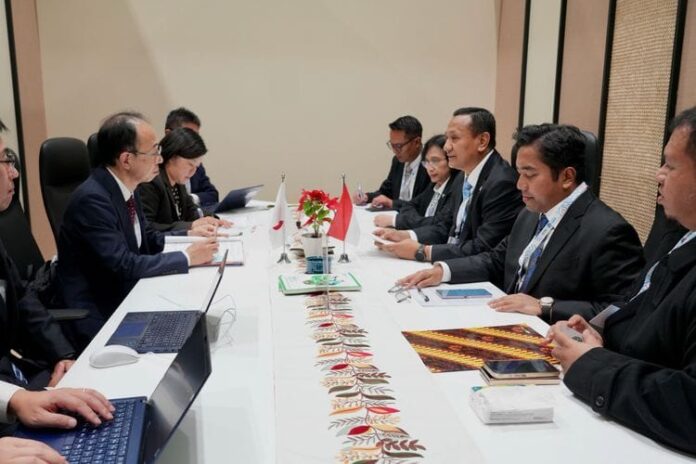
The discussions took place during a bilateral meeting between Indonesia’s Deputy Forestry Minister Rohmat Marzuki and Japan’s Vice Minister of the Environment Hiroshi Ono at the Indonesia Pavilion during the UN climate conference COP31 in Antalya, Türkiye, on Monday (Nov. 9, 2026).
Rohmat said Indonesia aimed to use Article 6 of the Paris Agreement and the bilateral JCM framework to develop high-integrity forestry carbon projects while generating economic benefits for local communities.
“We are seeking to build partnerships that connect high-integrity forestry carbon projects with economic growth, particularly at the community level,” he said.
Indonesia outlined four main commitments for forest carbon development: restoring 12 million hectares of degraded and severely degraded land through carbon removal projects; protecting 50 million hectares of forests from deforestation and degradation through carbon avoidance projects; developing social forestry carbon projects across 8.3 million hectares; and supporting customary forests covering 1.4 million hectares.
Rohmat said these commitments needed to be translated into credible projects supported by robust methodologies, effective environmental and social safeguards, and meaningful community participation.
He identified peatlands and mangroves as key components of Indonesia’s proposed JCM forestry portfolio, saying both ecosystems should become defining features of bilateral cooperation.
“Peatland and mangrove projects should be one of the main features of Indonesia’s forestry cooperation through the JCM and a distinctive contribution to high-integrity global climate action,” he said.
The discussions also covered potential opportunities linked to Japan’s Green Transformation Emissions Trading System (GX-ETS), which entered its mandatory phase in 2026. Japan has set a target of procuring around 100 million tonnes of carbon dioxide (CO₂) by 2030.
Indonesia’s Ministry of Forestry said it welcomed opportunities to develop and supply high-integrity nature-based carbon credits, particularly from projects to restore the country’s 12 million hectares of degraded land.
The proposed cooperation could help connect Japan’s demand for JCM-compliant carbon credits with Indonesia’s ecosystem restoration priorities. Beyond emissions reductions, the projects are expected to support biodiversity protection, ecosystem resilience and local livelihoods.
Rohmat stressed that biodiversity should be an integral part of the value of nature-based carbon projects. Their benefits, he said, should be assessed not only by the amount of carbon removed or avoided, but also by their contribution to biodiversity conservation, ecosystem resilience and community welfare. ***