
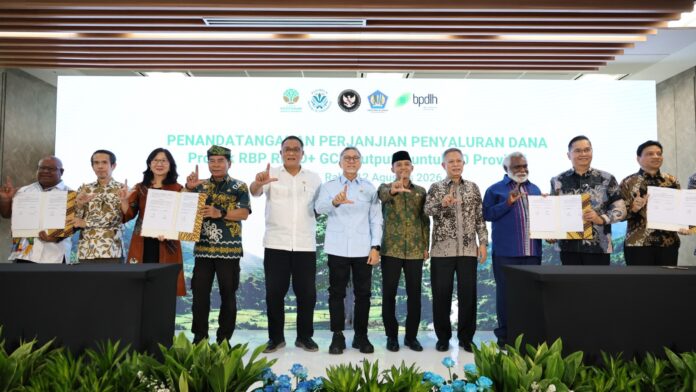
Ecobiz.asia – Indonesia has expanded its Results-Based Payment (RBP) REDD+ Green Climate Fund (GCF) program to 34 provinces after adding 10 new provincial governments, bringing the country’s total carbon finance commitment under the scheme to Rp761.02 billion (US$46.8 million).
The latest agreements, signed in Jakarta on Wednesday (Aug. 12, 2026), cover the provinces of Papua, North Kalimantan, East Kalimantan, Bangka Belitung Islands, West Nusa Tenggara, Aceh, Highland Papua, Maluku, South Sulawesi, and South Papua.
BPDLH President Director Joko Tri Haryanto said the new beneficiaries represent the third batch of provinces receiving performance-based payments under Indonesia’s REDD+ program.
“With this third batch, 34 out of Indonesia’s 38 provinces are now participating in the program. The remaining four provinces are expected to join the fourth batch before 2030,” Joko said after the signing ceremony.
The newly admitted provinces will receive approximately Rp253 billion in funding linked to verified achievements in emissions reduction and environmental management. Joko urged all beneficiaries to uphold integrity, professionalism and good governance in implementing the program.
The funding forms part of Indonesia’s RBP REDD+ Green Climate Fund program, under which the country became the first in the Asia-Pacific region to receive results-based payments from the Green Climate Fund. Indonesia secured US$103.8 million in recognition of verified emission reductions totaling 20.25 million tonnes of CO₂ equivalent from reduced deforestation and forest degradation.
Since Output 2 of the program was launched in August 2023, BPDLH has disbursed more than Rp500 billion, or around 37% of the total allocation, to support forest management and environmental programs across the country.
According to Joko, the program has expanded Indonesia’s Social Forestry initiative to more than 2 million hectares, supported community forestry groups, facilitated verification of more than 40 Indigenous forest proposals, and helped resolve land tenure conflicts in several regions.
The funding has also supported rehabilitation of approximately 3,000 hectares of degraded land, strengthened 150 Forest Management Units (KPHs) across 24 provinces, enhanced the capacity of community-based forest fire brigades, reinforced Indonesia’s National Registry System (SRN) and Climate Village Program (ProKlim), and supported sustainable waste management initiatives. Overall, the program has reached 1,266 villages across 225 districts.
Coordinating Minister for Food Affairs Zulkifli Hasan, who chairs BPDLH’s steering committee, said the environmental fund has become an important financing instrument linking environmental protection with economic development.
“Sustainable environmental management is the bridge connecting economic development and people’s welfare. BPDLH serves as Indonesia’s green financing instrument to support the country’s environmental sustainability agenda,” Zulkifli said.
Joko said BPDLH would continue expanding access to environmental finance to accelerate emissions reductions while improving livelihoods in forest-dependent communities.
“BPDLH has been mandated to manage environmental funds in an accountable, credible and transparent manner. We hope these funds will accelerate emissions reductions, strengthen sustainable forest management and improve local livelihoods,” he said.
Speaking at the same event, Forestry Minister Raja Juli Antoni said Results-Based Payments and the voluntary carbon market are complementary instruments for strengthening Indonesia’s carbon market ecosystem and supporting the country’s FOLU Net Sink 2030 target.
“Results-Based Payments reward measurable performance. They complement our broader regulatory framework in building a robust carbon market ecosystem,” Raja Juli said.
He added that Indonesia is also advancing the development of its voluntary carbon market, with jurisdictional nesting currently underway in 10 provinces to integrate project-level carbon activities into national accounting systems.
“Together, these initiatives will strengthen Indonesia’s carbon market ecosystem while delivering tangible benefits for local communities,” he said. ***