

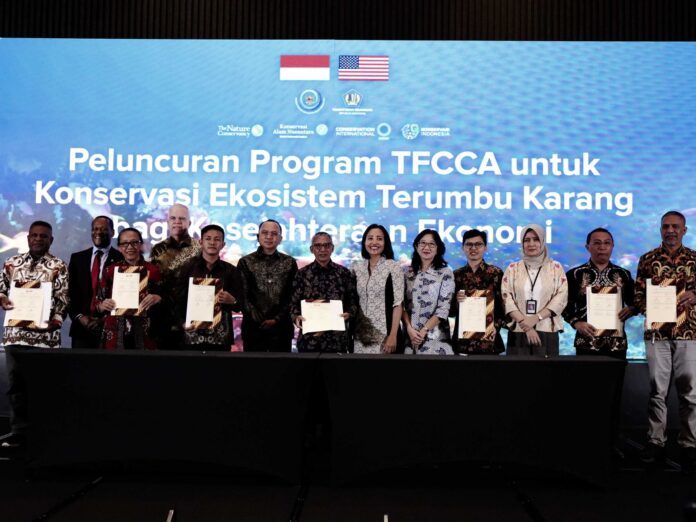
Ecobiz.asia — Indonesia has officially launched the first cycle of the Tropical Forest and Coral Reef Conservation Act (TFCCA) programme, deploying about US$35 million grants to support community-based coral reef conservation across the country.
A total of 58 local organisations and community initiatives have been selected to implement conservation projects in three priority seascapes — Bird’s Head (Kepala Burung), Lesser Sunda (Sunda Kecil), and Banda — all part of the global Coral Triangle, one of the world’s most biodiverse marine regions.
The programme’s rollout was marked by the signing of grant agreements by seven representatives of recipient organisations at a ceremony in Jakarta on Monday (Jan.26, 2026), signalling the start of the first TFCCA funding cycle.
TFCCA is the first financing mechanism globally designed to link coral reef conservation directly with community empowerment, converting sovereign debt obligations into grants for locally led environmental action. The programme is funded by the United States government and supported by additional contributions of US$3 million from Conservation International and Konservasi Indonesia, as well as US$1.5 million from The Nature Conservancy (TNC) and Yayasan Konservasi Alam Nusantara (YKAN).
Funding under TFCCA is aimed at protecting, restoring and managing coral reef ecosystems while strengthening livelihoods in coastal communities that depend heavily on marine resources.
U.S. Embassy Chargé d’Affaires ad interim Peter M. Haymond said the programme ties conservation outcomes to economic resilience.
“TFCCA transforms debt payments into grants that fund conservation efforts led by local communities. This is not only about protecting coral reefs, but also about strengthening food security, livelihoods and long-term prosperity,” Haymond said.
Indonesia’s Minister of Marine Affairs and Fisheries Sakti Wahyu Trenggono said the programme aligns with the country’s Blue Economy policy, which prioritises ecosystem sustainability amid mounting pressures from climate change, marine pollution and destructive fishing practices.
“TFCCA is also a form of blue diplomacy, connecting global partnerships with local action to advance inclusive and sustainable marine conservation,” Trenggono said.
As programme administrator, Konservasi Indonesia is responsible for ensuring transparent and accountable management of the grants. Its Senior Vice President and Executive Chair Meizani Irmadhiany said the role bridges strategic policy direction with on-the-ground implementation to ensure conservation targets are met.
From a global perspective, Kelvin Alie, Senior Vice President and Acting Head of Conservation Programs at Conservation International, described TFCCA as a strategic response to the accelerating marine biodiversity crisis, underscoring the importance of science-based interventions to strengthen social-ecological resilience in coastal areas.
William McGoldrick, Managing Director of TNC Asia Pacific, said the programme demonstrates how cross-country and multi-organisation collaboration can deliver long-term, community-driven conservation finance.
Echoing that view, YKAN Executive Director Herlina Hartanto stressed that active community participation is essential to ensuring the sustainability of marine protected areas.
The TFCCA grants were awarded through a competitive and transparent selection process. Of 323 proposals submitted by non-governmental organisations, community groups and local conservation practitioners, 58 were approved following independent technical and safeguards assessments. A second round of grant signings is scheduled for Feb. 28, 2026.
The first group of grant recipients includes indigenous and community organisations from Papua Southwest, West Nusa Tenggara, Maluku, Bali, East Nusa Tenggara and Southeast Sulawesi, reflecting the programme’s nationwide reach. ***