
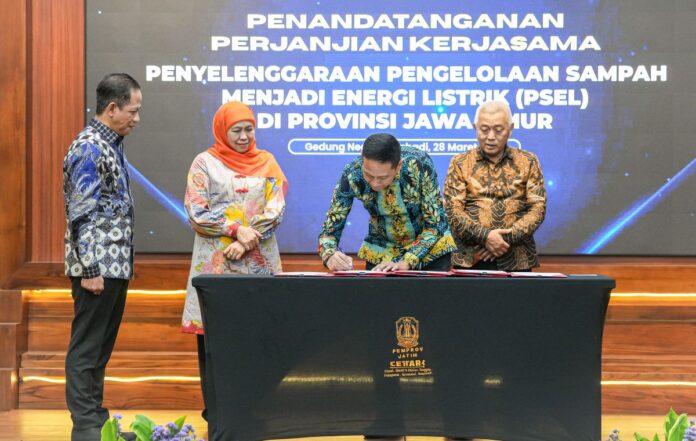
Ecobiz.asia — The signing of a memorandum of understanding (MoU) and cooperation agreements for waste-to-energy (WtE) projects in Greater Surabaya and Greater Malang marks a step forward in accelerating urban waste management projects in East Java.
The agreements involve the East Java provincial government and local administrations across the two metropolitan areas, following a directive under Presidential Regulation No. 109/2025 to fast-track the development of waste-to-energy facilities.
Environment Minister and head of the Environmental Control Agency (BPLH) Hanif Faisol Nurofiq said accelerating WtE development is key to addressing the growing urban waste crisis.
“Waste-to-energy is a solution to the urban waste emergency. President Prabowo Subianto has instructed us to accelerate development and prepare all necessary requirements,” Hanif said.
East Java Governor Khofifah Indar Parawansa expressed the region’s readiness to ensure smooth implementation through cross-regional coordination.
“The provincial government will continue to coordinate, monitor, and evaluate the projects, while facilitating the resolution of inter-regional issues,” she said.
Greater Surabaya — comprising Surabaya, Gresik, Lamongan, and Sidoarjo — generates around 3,692 tons of waste per day, with the planned WtE facility expected to have a capacity of 1,100 tons per day.
Meanwhile, Greater Malang — covering Malang city, Malang regency, and Batu — produces around 1,947 tons of waste daily, with the WtE facility planned to process approximately 1,038 tons per day.
Hanif added that the development of WtE projects in East Java is expected to improve waste management efficiency while generating renewable electricity, supporting the national target of achieving 100% waste management by 2029.
“East Java is currently the province with the highest managed waste rate in Indonesia, with more than 50% of waste already being handled,” he said. ***