
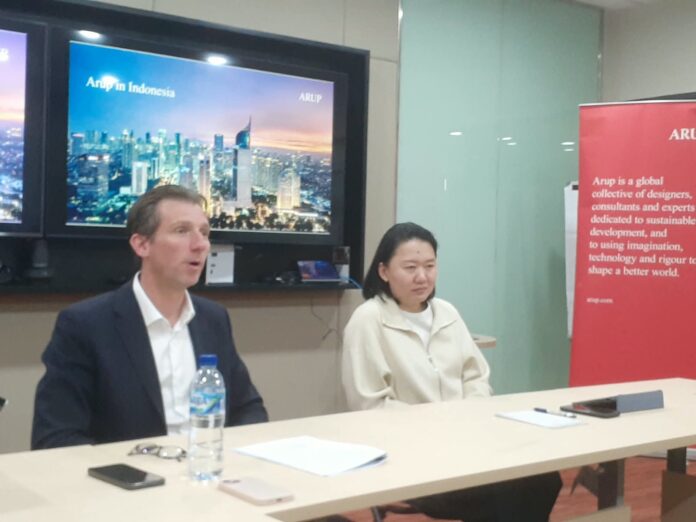
Ecobiz.asia — Global engineering and consulting firm Arup is targeting a doubling of its global energy business, with Asia-Pacific, including Indonesia, identified as a key growth market amid rising investment in renewable energy, battery energy storage systems (BESS) and electricity infrastructure.
John Ammentorp, Global Energy Leader of Arup, said the company’s growth ambition is driven not only by business expansion but also by its objective to support the energy transition and deliver greater impact for society.
“We have an ambition to double the size of our energy business — not just to be larger, but to have a bigger impact on society and the green transition as well,” Ammentorp told media, including Ecobiz.asia, during a media briefing at Arup’s Jakarta office on Friday (25/9).
He said Asia-Pacific is one of Arup’s main growth areas as countries across the region accelerate their energy development. “You can really see how fast things are moving here in Asia — it is one of the areas that we want to grow even further,” he said.
According to Ammentorp, Arup aims to support Indonesia and other Southeast Asian countries in unlocking their energy potential, particularly through the development and integration of renewable energy and electricity infrastructure. “Our focus is to unlock the potential which you especially have here in Indonesia, but also in Southeast Asia,” he said.
Ammentorp said Arup is already involved in several projects in the region, including interconnector developments, solar projects combined with BESS with a total capacity of up to 2 gigawatts (GW), and substation projects. He highlighted substations and electricity grids as a critical part of the energy transition, although they often receive less attention than new generation projects.
“The grid is actually what can unlock further implementation of production, while also making sure we can deliver on the demand that is increasing,” he said. He said the development of renewable generation capacity needs to be accompanied by sufficient transmission and distribution infrastructure to connect new power plants to consumers and accommodate growing electricity demand.
Arup’s current energy portfolio covers offshore wind, onshore renewable energy including solar and BESS, thermal power, hydropower, transmission and distribution networks, hydrogen and green fuels, as well as nuclear energy. The company says its energy work takes a whole-system approach rather than focusing on individual assets in isolation.
Ammentorp said this integrated approach is important because the energy transition involves not only adding generation capacity but also determining how electricity is connected, delivered and integrated into the wider system. “We’re not just looking at one asset at a time, but more: how can we have a holistic view on the energy system for the future?” he said.
He added that Arup’s focus is to help clients address what it describes as the energy trilemma: sustainability, affordability, and security and resilience. The company provides support ranging from strategy and planning to detailed engineering design and project delivery. “What is really important when we are delivering this is not just how big the ambition is on generation — it’s more how to unfold it, how to connect it, how to deliver it, how to make the right environment for investment, how to make bankable projects,” Ammentorp said.
He said this is where engineering and consulting firms can play an important role in helping governments, decision makers and developers mature projects so they can attract investment and move into implementation. Arup’s global energy business currently spans renewable energy, energy storage, transmission and distribution, hydrogen and sustainable fuels, integrated energy systems and nuclear, among other areas.
Ammentorp said Arup also seeks to leverage its global network to transfer knowledge between markets, allowing experience from projects in one region to be applied to projects elsewhere. “What is really important to us is to bring as much value to our clients as possible, and as well to society — really putting the biggest impact when we talk about energy and creating a better world, a more sustainable world,” he said.
He said the rapid pace of energy development in Asia provides significant opportunities for Arup to expand its contribution, particularly as countries seek to balance increasing electricity demand with decarbonisation and energy security.
For Indonesia, he said, strengthening the grid will be particularly important to unlock further renewable energy development and support future economic growth. “That’s where we as a consultant can support governments, decision makers and clients in maturing these projects,” he said.
He added that stronger energy infrastructure would not only facilitate the energy transition but also support economic activity, employment and broader prosperity across the region. “It’s also unlocking a future growth of society, jobs and prosperity in the different countries,” Ammentorp said. ***