
Ecobiz.asia – Indonesia’s 2025–2034 Electricity Supply Business Plan (RUPTL) could unlock around US$116.3 billion (Rp2,100 trillion) in power generation investment through 2034, with renewable energy projects accounting for the majority of the opportunity, according to an analysis by PwC Indonesia.
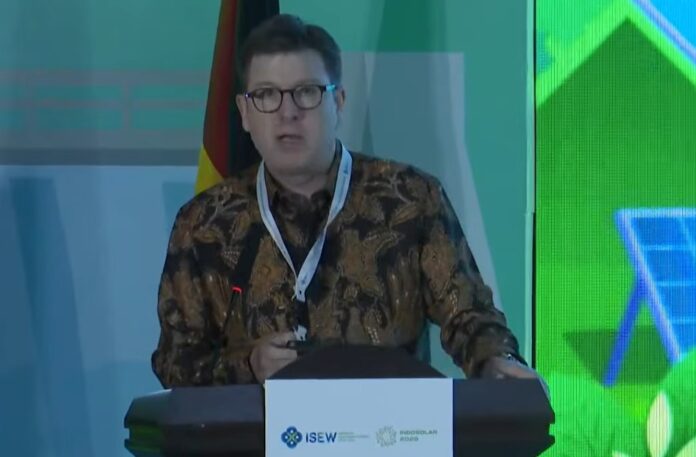
Sacha Winzenried of PwC Indonesia presented the estimate during Indonesia Sustainable Energy Week (ISEW) 2026 in Jakarta on Wednesday (August 19, 2026).
Of the projected generation investment, US$86.7 billion (Rp1,566 trillion) is expected to come from independent power producers (IPPs), including US$74.3 billion (Rp1,342 trillion) for renewable energy projects and US$12.4 billion (Rp224 trillion) for non-renewable generation.
PLN’s share is estimated at US$31.4 billion (Rp568 trillion), comprising US$18.9 billion (Rp341 trillion) for renewable generation and US$12.7 billion (Rp227 trillion) for non-renewable projects.
The investment opportunity extends beyond power generation. Transmission and other supporting infrastructure, including distribution and rural electrification, could require an additional US$31.3 billion (Rp565 trillion), creating further opportunities for grid equipment suppliers, engineering and construction companies, and financiers.
PwC’s analysis indicates that the scale of investment will depend heavily on how quickly Indonesia can accelerate renewable energy deployment. The country is expected to add around 53 GW of renewable capacity by 2034, requiring annual deployment to increase from roughly 1 GW currently to around 7 GW.
Java-Madura-Bali, Sumatra and Sulawesi are expected to account for a significant portion of the additional renewable capacity.
Solar power represents the largest planned renewable addition at around 17.1 GW, followed by hydropower at 11.7 GW, energy storage at 10.2 GW, wind power at 7.2 GW and geothermal at around 5.1 GW. The RUPTL also includes around 1 GW of other renewable energy capacity and 500 MW of nuclear power.
PwC identified procurement mechanisms as another key factor in turning the investment pipeline into actual projects. Around 71% of IPPs surveyed view direct appointment or direct selection mechanisms as an incentive for renewable energy investment.
The firm also identified standardized and bankable power purchase agreements (PPAs), more predictable tender schedules and improved tariff structures as measures that could make renewable energy projects more attractive to investors and lenders.
Grid development will also be critical as new renewable capacity is added. PwC said transmission infrastructure needs to expand toward areas with strong renewable energy resources, while renewable energy hubs and supporting grid infrastructure could help address connection constraints and reduce curtailment risks.
To support project financing, PwC pointed to blended finance, concessional loans, guarantees, equity participation and green capital market instruments as potential mechanisms to help projects reach financial close.
The investment push will take place alongside continued additions of conventional power capacity. The 2025–2034 RUPTL includes around 12.7 GW of new fossil-fuel generation, alongside 42.6 GW of renewable energy capacity and 10.2 GW of energy storage.
The combination means Indonesia will need to manage conventional capacity additions while accelerating the much larger buildout of renewable generation and the grid infrastructure required to integrate it. ***