
Ecobiz.asia — Governments across Asia and the Pacific have adopted a new regional roadmap to strengthen coordinated action on climate change, biodiversity loss, and pollution, recognizing that the region’s interconnected environmental crises require integrated policy responses rather than isolated solutions.
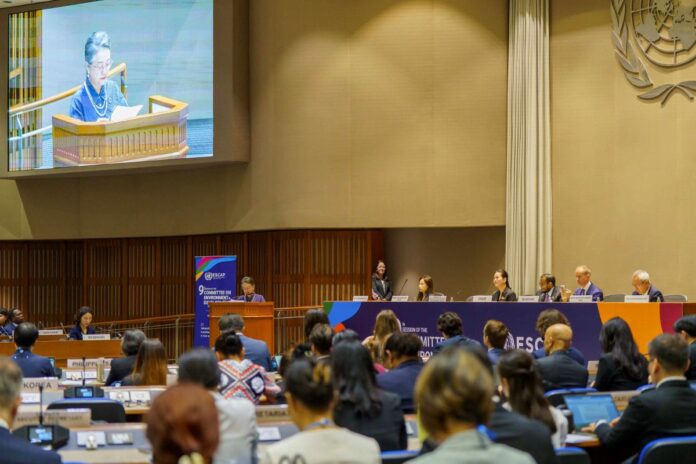
The agreements were adopted during the ninth session of the Committee on Environment and Development, convened this week by the United Nations Economic and Social Commission for Asia and the Pacific (ESCAP). Ministers endorsed the Ministerial Declaration on Environment and Development in Asia and the Pacific 2026 alongside the Regional Programme of Action on Advancing Synergies for Sustainable Development in Asia and the Pacific, 2026–2030.
The new framework aims to help countries better align environmental policies, financing, and institutions so that actions addressing one challenge can generate broader benefits across climate, biodiversity, and pollution agendas while accelerating progress toward global and regional sustainability commitments.
The initiative comes as Asia and the Pacific face mounting environmental pressures. At the current pace, 88% of measurable environment-related Sustainable Development Goal (SDG) targets are projected to be missed by 2030, while 90% of the region’s population is exposed to unsafe levels of air pollution. Climate change, biodiversity loss, and water insecurity continue to threaten livelihoods, economic growth, and ecosystems.
“Fragmented responses are inefficient and cannot keep pace with interconnected challenges,” said Armida Salsiah Alisjahbana, United Nations Under-Secretary-General and Executive Secretary of ESCAP.
“Advancing synergies is a practical necessity for achieving better development outcomes while making the best use of increasingly constrained financial, institutional and technical resources.”
The declaration also highlights the need for stronger international support, particularly for climate-vulnerable countries facing growing adaptation and mitigation costs.
“Access to predictable, adequate and grant-based finance remains critical,” said Ali Shareef, Maldives’ Minister of Climate Change, Environment and Energy, who chaired the committee session.
“Climate-vulnerable countries should not face additional financial burdens in responding to a crisis we did little to create.”
ESCAP said the new regional agenda builds on growing environmental commitments across Asia and the Pacific. According to the organization, 39 member states have adopted carbon neutrality or net-zero targets, 46 countries have incorporated nature-based solutions into national climate or development policies, and 25 of the 27 coastal countries that submitted updated national climate plans now include ocean-based measures.
Earlier this week, ESCAP also launched the Asia-Pacific Synergies Report, developed in partnership with the Asian Development Bank (ADB), the United Nations Environment Programme (UNEP), and the Institute for Global Environmental Strategies (IGES) with support from the Government of Japan.
Drawing on more than 140 case studies, the report concludes that integrated governance, innovative financing, and improved data systems can help countries address climate change, biodiversity loss, and pollution simultaneously while accelerating sustainable development across the region. ***