
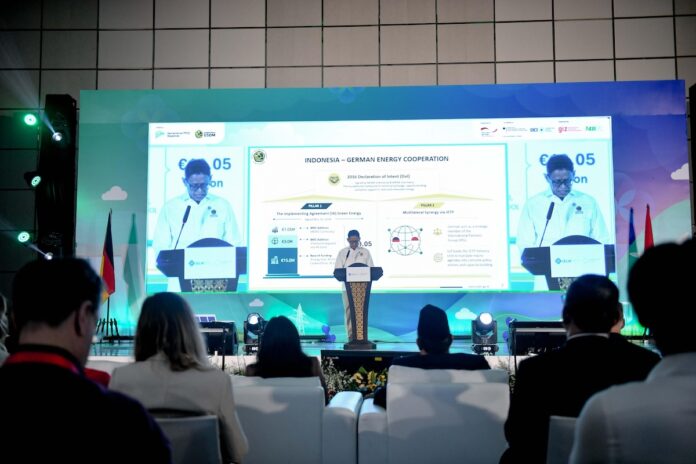
Ecobiz.asia – Indonesia and Germany are implementing and preparing a broad portfolio of energy projects with a combined committed budget of €2.3 billion (Rp47.6 trillion), covering hydropower, geothermal energy, electricity transmission, carbon pricing and a €300 million (Rp6.21 trillion) Green Energy Corridor in Sulawesi.
Deputy Energy and Mineral Resources Minister Yuliot presented the portfolio during Indonesia Sustainable Energy Week (ISEW) 2026 in Jakarta on Wednesday (August 19, 2026).
Among the largest projects are renewable energy programs supported by German development bank KfW, including €368 million (Rp7.62 trillion) for hydropower projects in Bakaru, Kumbih and Sawangan, scheduled to run from 2017 to 2037.
The portfolio also includes a €69.7 million (Rp1.44 trillion) small hydropower program running through 2033 and €210 million (Rp4.35 trillion) for geothermal projects in Kamojang, Ulumbu and Mataloko through 2035.
Electricity grid development is another major component of the cooperation. Projects include a €300 million (Rp6.21 trillion) program to expand sustainable energy access in eastern Indonesia and a €63.9 million (Rp1.32 trillion) Sustainable and Reliable Energy Access Program scheduled through 2037.
A separate €300 million Green Energy Corridor Sulawesi project is also included in the cooperation portfolio, alongside the RE2Grid and FlexGen programs aimed at strengthening transmission and distribution systems as Indonesia integrates more renewable energy into its power grid.
The Indonesia-Germany cooperation also extends beyond physical infrastructure to policy and technology development.
Current and planned programs cover carbon pricing, energy-transition regulation, hydrogen, renewable-energy cooling, energy efficiency and project preparation.
The Carbon2Price program supports the development of mechanisms for carbon monetization, while H2Upp focuses on accelerating the international hydrogen market. The portfolio also includes planned cooperation on biogas and the development of an implementation model for an inclusive and just energy transition.
Separately, the Ministry of Energy and Mineral Resources and GIZ currently have nine active bilateral energy projects with a combined commitment of €50.2 million (Rp1.04 trillion).
Indonesia and Germany have cooperated in the energy sector for more than four decades, with the current portfolio covering energy policy and regulation, renewable energy deployment, transmission infrastructure, energy efficiency and demand-side innovation. ***