
Ecobiz.asia — Indonesia and the Democratic Republic of Congo (DRC) have agreed to strengthen collaboration in developing a high-integrity carbon market and promoting sustainable management of tropical forests.
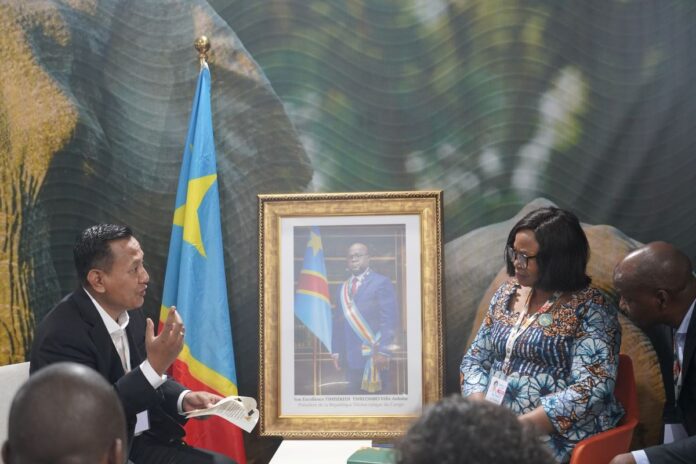
The commitment was reaffirmed during a bilateral meeting between Indonesia’s Deputy Minister of Forestry, Rohmat Marzuki, and DRC’s Minister of Environment, Sustainable Development, and New Climate Economy, Marie Nyange Ndambo, on the sidelines of the UNFCCC COP30 Climate Summit in Belém, Brazil, on Tuesday (Nov. 11, 2025).
Indonesia commended the DRC for its leadership in strengthening carbon market governance through the establishment of the Autorité de Régulation des Marchés du Carbone (ARMCA), marking an important milestone in the country’s national carbon market framework.
“This is a remarkable step forward in building a high-integrity carbon market and strengthening forest governance. Indonesia appreciates DRC’s leadership across the Congo Basin,” Rohmat said.
He added that Indonesia continues to strengthen its own carbon market policy through Presidential Regulation No. 110/2025 on Carbon Economic Value, which places carbon trading as a key instrument for green growth and a low-carbon economy. Under this framework, carbon units generated from nature-based solutions — such as reforestation, mangrove restoration, and agroforestry — can be traded both domestically and internationally.
To support implementation, Indonesia is finalizing several derivative regulations, including revisions to Regulations No. 7/2023, No. 8/2021, and No. 9/2021, along with a new regulation on ecosystem services utilization in conservation areas. These reforms aim to transform the forest carbon economy into a new driver of inclusive green growth.
The initiative aligns with President Prabowo Subianto’s national agenda to rehabilitate 10 million hectares of degraded and critical land as part of the FOLU Net Sink 2030 program, under which Indonesia’s forestry sector is expected to become a net carbon sink by 2030.
The ministry is also advancing palm-based bioenergy production, projected to reach 24 million kiloliters of bioethanol and reduce fuel imports by up to 50 percent.
Social forestry remains another key pillar of the strategy. So far, 8.4 million hectares of community-managed forests have been allocated, benefiting 1.4 million households and creating 5.6 million green jobs across the country. Indonesia has also facilitated the recognition of 70,688 hectares of customary forests, with a target of 1.4 million hectares by 2029.
Recently, Indonesia signed cooperation agreements with the International Emission Trading Association (IETA) and the Integrity Council for the Voluntary Carbon Market (ICVCM) to enhance capacity building, technical collaboration, and private-sector participation — essential elements of a credible, globally connected carbon market.
Rohmat also underscored the importance of strengthening South-South cooperation in forestry. Indonesia and the DRC have previously collaborated through the International Tropical Peatlands Center (ITPC) and the Global Peatlands Initiative, facilitating research and knowledge exchange among tropical forest nations.
“Based on this foundation, Indonesia is ready to collaborate with the DRC in developing carbon markets in the forestry sector. We share the same commitment — to protect tropical forests while advancing economic and social prosperity,” he said.
The DRC also expressed interest in reviving the tri-nation coalition among Brazil, Indonesia, and the DRC, first established at the COP26 in Glasgow, and to enhance cooperation through the ITPC framework. Both countries agreed to intensify communication to follow up on these initiatives. ***